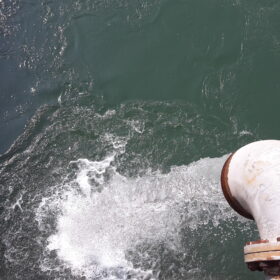
Green hydrogen and its water use problem
The climate crisis threatens water management and the water crisis in Montevideo, Uruguay, in 2023 illustrates the damage new industrial projects could cause if not thoroughly assessed. With green hydrogen projects gaining international prominence, it is vital they are properly planned.
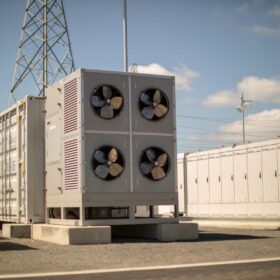
Australian state allocates 350 MW of solar, 4,000 MWh of storage in tender
Five energy infrastructure projects representing 750 MW of renewable energy generation and 524 MW/4,192 MWh of long-duration storage have been successful to the New South Wales government’s latest tender round, as it prepares for the exit of coal-fired power generation from the Australian state’s electricity grid.
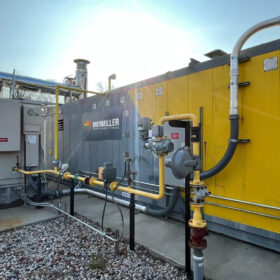
Brenmiller Energy commissions thermal energy storage demonstration project
Brenmiller Energy’s thermal energy storage demonstration system at the State University of New York uses crushed rocks to store energy from renewables or the grid.

Morocco reveals bidders for 400 MW/400 MWh solar-plus-storage tender
Morocco has announced the pre-qualified bidders for the 400 MW Noor Midelt III solar project, with 400 MWh of battery storage.
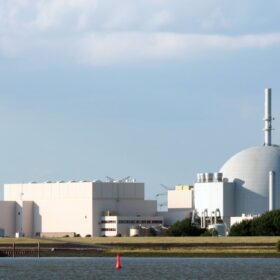
German decommissioned nuclear plant to become 800 MW/1,600 MWh battery
PreussenElektra has revealed plans to potentially develop Europe’s largest battery storage facility at the decommissioned Brokdorf nuclear power plant site in Germany, with 800 MW/1,600 MWh of capacity. The site operator now needs to secure approval to dismantle the nuclear plant.
White hydrogen project sparks interest in France
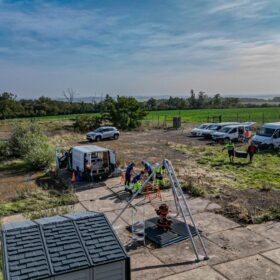
Philippe de Donato and Jacques Pironon, researchers at a French laboratory, are actively searching for white hydrogen in collaboration with gas company Française De l’Énergie. Pironon told pv magazine that they plan to continue exploration next year to confirm their thesis that deeper digging yields more hydrogen.
Weekend Read: Famine to feast – China’s solar market in 2023
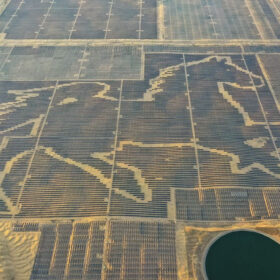
China’s solar industry rebounded in 2023 after years of pandemic-related sluggishness. As the year draws to a close, pv magazine looks back at key highlights of 2023 and considers the prospects for 2024.
The Hydrogen Stream: BayoTech to launch two US hydrogen hubs in 2024
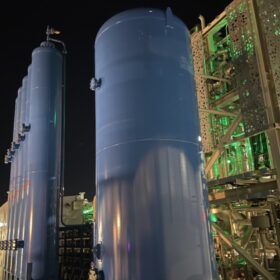
BayoTech and Versogen are increasing their investments in low-carbon hydrogen in the United States, while the UK government has announced backing for 11 green hydrogen projects, canceling plans to use hydrogen for household heating.
Belgian grid operator publishes grid capacity map
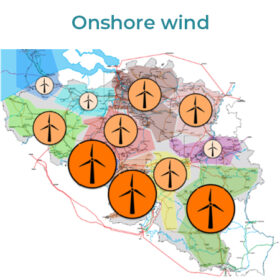
Belgian network operator Elia says its new grid map shows available capacity, in addition to existing and already reserved capacity. The map, which considers growth in residential load and generation, shows that there might still be enough free capacity for 3.3 GW of solar and 2.8 GW of storage.
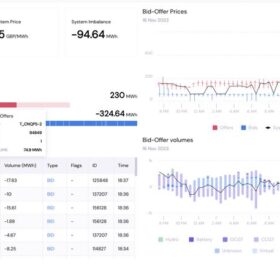
Battery energy storage analytics platform Modo Energy secures $15 million
UK-based Modo Energy, a battery analytics platform developer, has raised $15 million to finance new product development and develop international markets.
