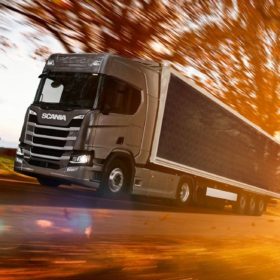
Scania develops solar cell-clad trailer
The 18-meter long solar cell-clad trailer is said to enable fuel savings of 5-10% in Sweden. Swedish thin-film manufacturer Midsummer is a partner on the project.

Solar tower for world’s largest pasta producer
The German Aerospace Center is working with partners in Italy to supply Italian pasta maker Barilla with electricity and heat from renewable sources.
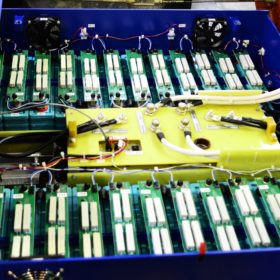
Russian nuclear giant Rosatom enters storage business
The state-owned company will manufacture module type lithium-ion traction batteries for electric vehicles, as well as energy storage systems for emergency power supplies, renewable energy resources, and the smoothing of load demand.
China will need 1.9 TW of solar by 2060 to hit net zero – WoodMac
The bill for full decarbonization of the economy – which is likely to see the decommissioning of no more than half the current coal fleet, with CCS doing some heavy lifting, according to the US-owned analyst – could come in at more than $5 trillion.
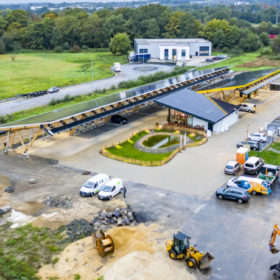
Solar-wind-storage EV fast charging for German highway
Fastned and Tesla have opened what they claim is the largest fast-charging park in Germany. Electric vehicles will be charged with green electricity – some of it from on-site solar and wind generation and the project includes 2 MWh of battery storage.
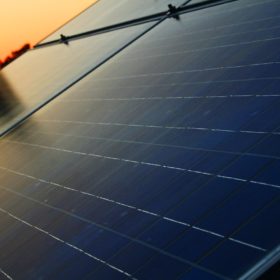
Schneider Electric launches off-grid-capable solar charge controller
The power electronics company is offering a product which can work on and off the grid and enables the charging of dead batteries using a rooftop solar array.
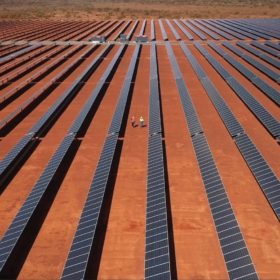
‘There has never been a better time for hybrid microgrids’
In a move that’s sure to pan out well for the Granny Smith gold mine in Western Australia, Aggreko has installed one of the country’s largest renewable energy microgrids, with 7.7 MWp of solar to be integrated with the site’s existing power station. pv magazine recently sat down with Karim Wazni, Aggreko’s managing director of microgrids and storage solutions, to discuss how microgrids and energy storage can help transition Australia’s resource sector.
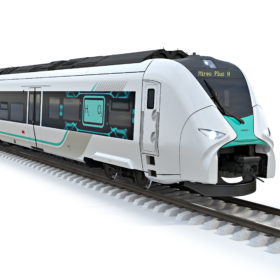
New Siemens units lay marks in hydrogen generation, mobility and energy-as-a-service
With a flurry of recent announcements, the newly-launched power division of the electronics giant plans to drive hydrogen mobility in Germany and enter the commercial and industrial power market in the US.
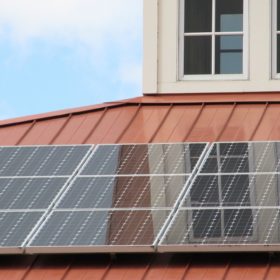
US residential solar set for a record-breaking year — despite, and because of, 2020
With folks housebound by Covid-19 restrictions and more conscious of their home energy needs, April proved a banner month for companies generating digital leads through their own accelerated transition to a new way of working.
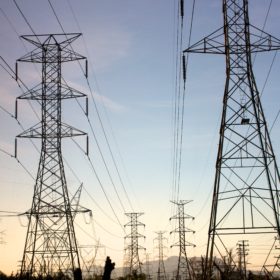
France’s ‘virtual power line’ takes shape
Nidec has deployed a 12 MW/24MWh storage system for French grid operator RTE. The battery – part of a 72 MWh project to prevent grid congestion in peak demand periods – is in an area with abundant renewables, including wind.
