Renewable energy heat batteries for industrial applications
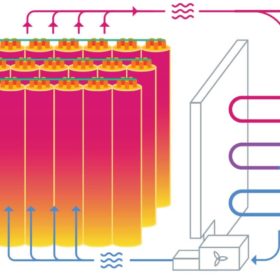
Startup Rondo Energy closed a $22 million Series A funding round to decarbonize industrial processes with equipment that converts solar and wind energy into thermal energy.
The Hydrogen Stream: Fortescue develops tech based on photocatalytic water splitting coupled with solar
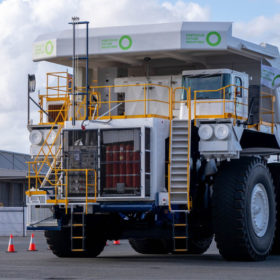
Australia’s Fortescue Future Industries wants to develop a green hydrogen technology based on photocatalytic water splitting coupled with solar radiation. Elsewhere, Linde has signed a long-term agreement with German chemical company BASF for the supply of hydrogen and steam in France and Nel has received a contract for a containerized PEM electrolyzer and light-duty hydrogen fueling station package from an unnamed U.S. power utility.
Doped carbon for a reliable lithium sulfur battery
Scientists in South Korea developed a porous carbon material that, when applied as a coating to the separator film in a lithium-sulfur battery, was shown to reduce an unwanted side effect and improve the battery’s performance and reliability. The coating is based on methylene blue, a type of salt commonly used in textile dying.

Iberdrola moves forward with Portugal’s largest pumped-hydro storage project
The Spanish energy company is building a huge hydropower complex across three water reservoirs in northern Portugal. The project will rely on 880 MW of pumped-hydro storage and is expected to become fully operational in 2024.
Storing solar power with grid-scale molten hydroxide
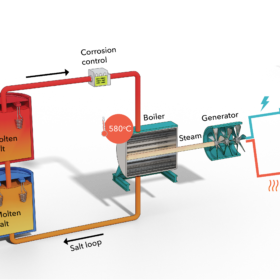
Seaborg Technologies, a Danish manufacturer of molten salt nuclear reactors, has turned a technology that was originally developed for nuclear power into a large-scale storage solution for wind and solar. It has developed a storage system that uses renewable energy to heat salt with electrical heaters, based on two-tank molten salt storage designs developed for concentrated solar power plants.
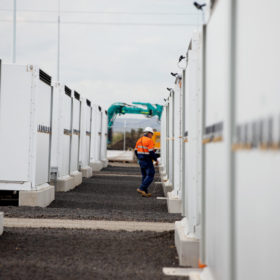
Australia’s battery capacity to double in 2022
After the deluge of announcements last year, 2022 will see the trickle of big batteries actually operating in Australia turn to a flood. According to Rystad Energy, the country’s battery capacity is set to double before the year is out.
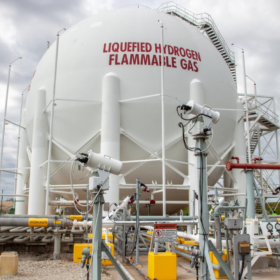
Large-scale storage options for compressed hydrogen
Researchers from Finland and Sweden have reviewed different ways to store compressed gaseous hydrogen, including storage vessels, geological storage, and other underground options.
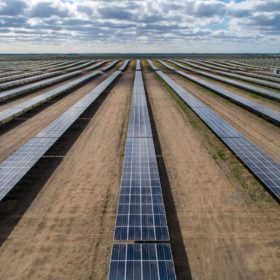
Investors submit 34GW of wind, solar, storage for renewables zone in Australia
The New South Wales state government in Australia has revealed that more than 34GW of new solar PV, wind and energy storage projects have been proposed for the South-West Renewable Energy Zone.
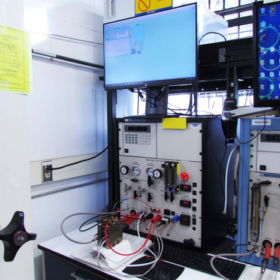
The Hydrogen Stream: New fuel cell design to solve longstanding problem of overheating
Los Alamos National Laboratory researchers developed a new polymer fuel cell that is claimed to solve the long-known issue of overheating. Furthermore, Mexican cement producer Cemex invested in HiiROC, a UK-based hydrogen production startup, which developed a scalable technology that uses thermal plasma electrolysis to convert biomethane, flare gas, or natural gas into hydrogen at a reportedly lower cost than competing solutions.

Forget batteries, what if surplus renewable energy could be stored as information?
A pair of researchers from UC San Diego has proposed to precompute certain data when the grid is flooded with solar or wind power, and then store it on servers for later use.
