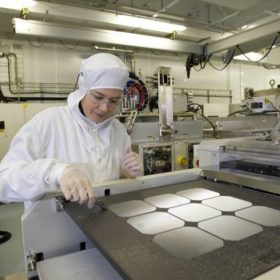
Ultra-thin silicon layers for 22.2%-efficient heterojunction solar cell
Scientists in the Netherlands fabricated a heterojunction solar cell with a layer of hydrogenated nanocrystalline silicon just three nanometers thick. The cell’s efficiency was measured at 22.2%, below the highest achieved with HJT cells, however, the researchers note that successfully incorporating this material into the cell stack will open many new doors for improvement.
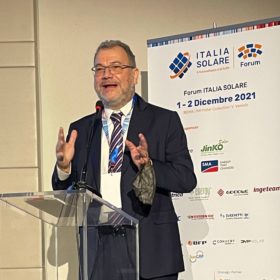
New provisions may help Italy unlock 110 GW PV project pipeline with grid-connection requests
The Italia Solare Forum event held in Rome last week has shown, once again, that permitting for both large scale and distributed generation projects remains the main barrier to remove to make Italy get the benefits of its huge solar potential. Despite recent progress, new provisions, and a slight increase in new PV capacity, the Italian market may be, again, unable to surpass 1 GW this year.
Indian manufacturer plans 1.2 GW module fab
Gujarat-based solar manufacturer Solex plans to have 1 GW of cell and 3.7 GW of module capacity operational in 2023.
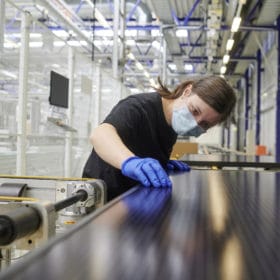
Eurostat: EU had €6.2 billion solar panel trade deficit in 2020
The European Union’s statistics body said three-quarters of the solar modules imported to the bloc last year came from China.
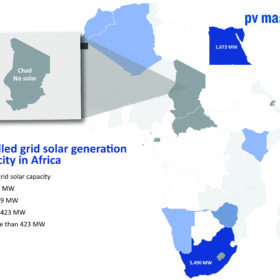
Chad’s first solar-plus-storage project secures funding
The development entity driving the first stage of a planned 60 MW solar plant has announced a doubling in the amount of borrowing secured for a project which was supposed to be operational in 2018.

Developers submit 4.1 GW of PV projects for first 2021 round of Dutch SDE++ program
The Dutch Ministry of Economic Affairs and Climate Policy is now reviewing 54,109 renewable energy projects totaling 5.17 GW in the first round of the SDE+ program for 2021. Solar accounts for around 80% of the total submitted capacity.
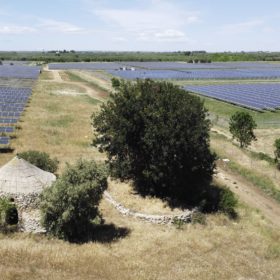
The weekend read: Green shoots appearing in the Italian PV market
A surge of Italian PV project activity is soon expected if the local authorities get out of the way. With the market, financial and policy settings in place, the market is set to see a return to bustling PV project activity, with regulatory reforms clearing the way forward, reports Sergio Matalucci in Milan.
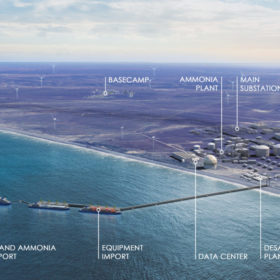
The Hydrogen Stream: 8 GW green hydrogen project announced in Chile
Meanwhile, on the Iberian Peninsula, H2 Green Steel (H2GS) and Iberdrola plan to establish a 1 GW green hydrogen production facility, and Acciona and Plug Power want to deploy green hydrogen facilities across Spain and Portugal.

TSEC plans to raise solar cell, module production capacity to 1.5 GW
The Taiwanese solar manufacturer has raised US$22 million through a private placement of shares and will use the funds to support its solar capacity expansion plans.
Covid-19 forces Meyer Burger to reduce solar module output, increase panel prices for 2022
An above-average employee sickness absence is forcing the Switzerland-based solar panel manufacturer to slow down production until the end of January. Meyer Burger has also informed customers that the prices for its solar modules will rise in the coming year.
