
South Korea deployed 4.1 GW of solar in 2020
Last year saw a record for solar, in terms of newly deployed capacity. This year, however, growth may be limited by new regulations for project siting.
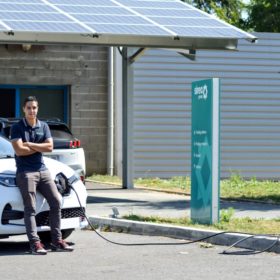
EV recharging station powered by solar, hydrogen
The recharging station was designed by French automation group Sirea. It is powered by a solar carport and a small electrolyzer.

Polyelectrolyte-based inverted perovskite solar cell with 20.29% efficiency
Taiwanese researchers have added bathocuproine (BCP) molecules to three different kinds of solvents used in perovskite cells and have ascertained how this combination increases the carrier mobility and passivates the electron-poor defects. Furthermore, they utilized a polyelectrolyte (P3CT-Na) thin film as hole transporting material instead of commonly-used thin films based on PEDOT:PSS.
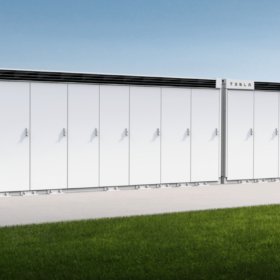
Queensland to integrate large-scale community batteries into substations
The state government of Queensland, Australia, will install five community batteries at regional substations in a bid to time-shift its abundant solar resources.
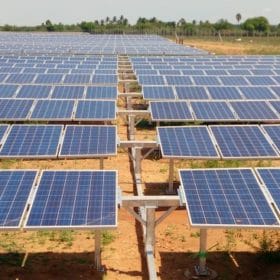
India’s cumulative PV capacity hits 39.1 GW
India had 39.1 GW of grid-connected solar and 216 MW of off-grid projects in operation by the end of February. The state of Karnataka leads with 7.4 GW of installed solar capacity, followed by Rajasthan with 5.5 GW and Tamil Nadu with 4.4 GW.
Guide to help installers detect hidden costs in high-power modules
Spanish PV product distributor Techno Sun has published a report analyzing the consequences of high-power modules for installers and distributors. The guide provides a method to calculate the additional costs of large solar panels from different points of view.
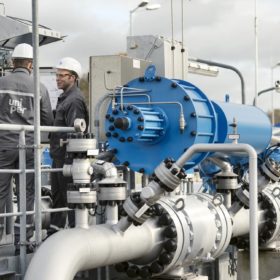
Incentives crucial to avoid green, blue, and even purple hydrogen fading to grey
An Anglo-German report has suggested the environmentally-friendly desire to use only clean power to produce hydrogen, outlined by nations such as Germany, could end up being more emissions-heavy than the more pragmatic embrace of blue hydrogen under consideration in the U.K.
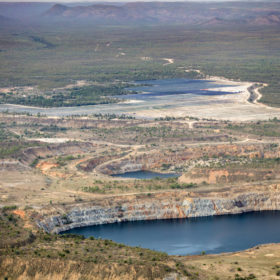
Australian developer to start building 250 MW pumped hydro plant
Construction is expected to commence in the weeks ahead on the massive 250 MW Kidston Pumped Hydro Storage Project in Queensland, as developer Genex Power has announced a $115 million share issue that will deliver the funds for the project to proceed.
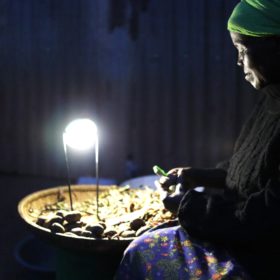
Entire village in Malawi to receive solar in pilot project
It is hoped 100% solar home system installation–with householders able to buy, or lease on a PAYG basis–will offer a template for installation in remote communities across Africa.
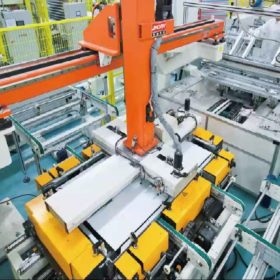
Chinese PV Industry Brief: Another factory under construction
Talesun has begun work on its 5 GW factory in Siyang county, Jiangsu province and China’s second-largest grid operator, China Southern Power Grid, has announced around 200 GW of renewable energy capacity will be deployed on its service area over the next 10 years.
