
Transitioning to larger wafers
Since 2017, 156.75 mm M2 wafers have been the standard. However, improvements in cell efficiency appear to have hit a bottleneck, making wafer size a hot topic among manufacturers once again. In the second half of 2018, 158.75 mm G1 mono wafers were introduced to the market. Corrine Lin of PVInfoLink argues that while G1 will likely become the mainstream format over the next two years, 166 mm M6 wafers and 210 mm M12 wafers are presenting new options for manufacturers.
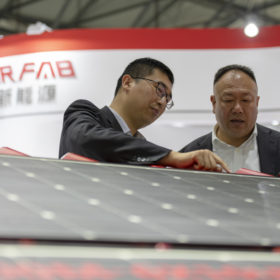
China added 12 GW of solar last month for 30 GW annual figure
An insider at the China Photovoltaic Industry Association has told pv magazine there was an end-of-year rally after less than 18 GW of new capacity was installed to the end of November.

China holds firm on strategy to build self-sufficient domestic polysilicon industry
The Chinese government will extend duties on U.S. and South Korean polysilicon for another five years from today despite committing to buy $200 billion more American goods and services in the trade deal signed on Wednesday. Poly manufacturer REC Silicon says it expects polysilicon to form part of that trade agreement.

Total and Marubeni win Qatar’s 800 MW solar tender
The resulting project will sell power to Qatar General Electricity and Water Corp under a 25-year power supply deal. French oil and gas giant Total and Japanese conglomerate Marubeni will hold a combined 40% stake in the power plant, which will be built near Doha, the Qatari capital.

The weekend read: Your guide to market growth in 2020
Some 15 countries are likely to be able to lay claim to the status of being members of solar’s “gigawatt club” in 2019, according to conservative projections from BloombergNEF. Nonetheless, PV suppliers, developers and service providers are always on the lookout for new pockets of growth. To kick off 2020, pv magazine’s global team of correspondents and editors have highlighted 10 “fast-growing” solar markets to evaluate where the opportunities, and potential risks, lie.

Portugal pushes back solar auction to March
The minister of environment and energy transition has told parliament two auctions for large scale solar will be held this year, with a new procurement round now planned. The minister revealed energy storage may play a part in the capacity tenders.

SolarPower Europe repeats call for solar strategy as part of European Commission’s €1tn Green Deal
Lobby group CEO Walburga Hemetsberger says the plans announced by commission president Ursula von der Leyen this week should place the European solar industry front and center.

BlackRock vows to exit coal as part of new climate-focused investment strategy
The U.S. asset management fund’s plan to cut future investment in coal is reportedly part of a climate-focused initiative to establish sustainability at the center of its business approach. The announcement comes weeks after the investor closed $1 billion of a record $2.5 billion fund focused on PV, wind and energy storage projects.
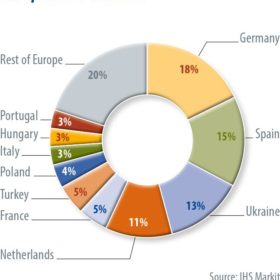
A new era of sustained growth
After several years of weak solar demand growth in Europe, compared to the historical highs of 2011, installations are expected to surge by 88% to reach a new installation record of 23 GW in 2019, writes Cormac Gilligan, research manager at IHS Markit. A range of favorable macro conditions have coalesced this year to reignite the market.

US government expects 24 GW of new solar this year
A Department of Energy agency expects 17.4 GW (DC) of utility scale solar power generation capacity plus 6.6 GW of small scale PV will be installed in 2020. That volume would be 60% higher than the record, set in 2016.
