
Researchers complete Europe’s first PV soiling loss assessment
A European research group has adapted a soiling model for use across the continent, analyzing scenarios with complete and partial rain cleaning to calculate energy losses and increases in the levelized cost of energy (LCOE), marking Europe’s first techno-economic PV soiling assessment.
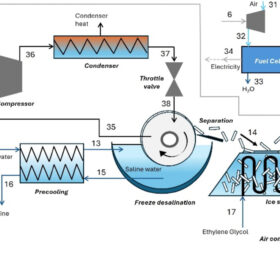
PV-powered system to desalinate water, produce H2 for desert agriculture
Scientists have proposed a standalone system that uses freeze desalination and ice for air conditioning. It requires 10,785 square meters of c-Si bifacial PV panels and can operate throughout the day. Energetic efficiency is calculated as 17.8% during the day and 56% at night.

UN invests $700,000 in 120 kW hybrid solar plant in DR Congo
The United Nations Development Program (UNDP) has invested nearly $700,000 to build a 120 kW hybrid solar plant in Mambasa, Democratic Republic of the Congo. The community PV project will supply power to more than 300 users, including six health centers, 224 small businesses, and 89 households.

Agrivoltaics for peppers
Scientists have built in India a 1.8 kW agrivoltaic setup to grow peppers under the PV modules. The proposed project design is described as an agrivoltaic insect net house that could be use for all crops that require rigorous pest management.
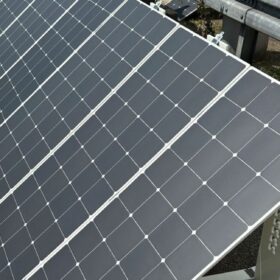
British Columbia offers funding for First Nations renewables
The Canadian province of British Columbia has allocated CAD 7.7 million ($5.5 million) to projects in seven communities, including a 3.8 MW solar farm, energy storage, and a pre-feasibility study on hydrogen production.

Serbia sets maximum solar price of €72/MWh for second renewables auction
Serbia’s upcoming second renewables auction, scheduled for later this month, aims to procure 124.8 MW of solar power with a ceiling price of €72 ($75.30)/MWh. This price is lower than the €90/MWh ceiling offered in the country’s first renewables auction last year.
Greek researchers develop privacy-preserving PV forecasting technique
Researchers from Greece have developed a PV forecasting technique for prosumer schemes using federated learning, a machine learning method that sends local model updates to a central server for correction. Their simulations show surprising results compared to centralized forecasting.
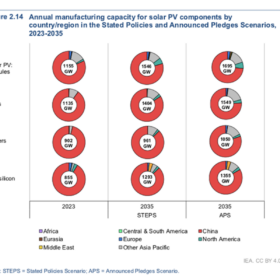
Solar module manufacturing capacity could exceed 1.5 TW by 2035, says IEA
The International Energy Agency’s (IEA) latest report, which maps out the future evolution of clean energy manufacturing, says the combined global market for PV, wind turbines, electric cars, batteries, electrolyzers, and heat pumps will rise from $700 billion in 2023 to more than $2 trillion by 2035.

Sri Lanka to install rooftop solar at religious sites
Buddhist temples, churches, mosques and Hindu temples across Sri Lanka are receiving 5 kW rooftop solar installations free of charge. The project, backed by a $17 million investment from the Indian government, is expected to add 25 MW of solar to the grid.
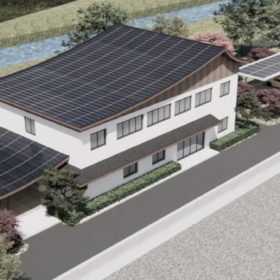
Trinasolar Evergreen unveils BIPV products for industrial, public use
Trinasolar Evergreen (Shanghai) PV Tech. Co., Ltd., a building-integrated photovoltaics (BIPV) unit of Trina Solar, has launched four new products for public, industrial, and infrastructure projects. Trina Solar aims to capture a share of the fast-growing BIPV market.
