
Prodiel, Everwood set up joint venture
Called DVP Solar, the newly created company has projects in Spain, France, Germany, Italy, Colombia and Peru, and manages 5 GW of photovoltaic plants in operation. It also has another 2 GW of projects in the initial development phase, and plans another 3 GW for the coming years.
UK renewables developer Anesco changes hands
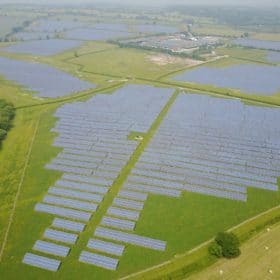
Private equity funds in Ireland and the U.S. have moved for the English company, which developed and sold the first subsidy-free solar farm in England, the 6 MW Clayhill project in Flitwick.

Photovoltaics and geothermal heat pumps for domestic hot water heating
According to a new study from LUT University, domestic water heating costs may be reduced by combining rooftop PV with geothermal heat pumps. Scientists developed a control method to minimize these costs by taking advantage of cheap spot market electricity and maximized PV power generation, as well as considering heat demand, PV generation forecasts, and heat pump efficiency.
UK and Norwegian governments back solar-plus-storage in Mozambique
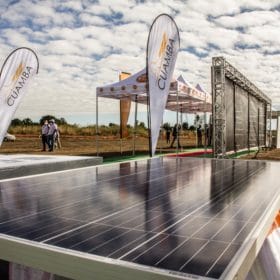
A solar array planned in the Tetereane district of Cuamba has been described by its developer as the nation’s first independent power project to feature utility scale storage.

Upscaling PV-powered irrigation in India
India’s PV-powered irrigation mission has had a sluggish run, even though the PM-KUSUM scheme provides flexibility and budgetary support for system implementation. An IEEFA report highlights the need to address key challenges at state level to increase deployment.

Solar makes a lot of sense at ground level, too
Solar projects that support native grasses can sequester more carbon than farmland alone.
The weekend read: Driving toward the European solar inflection point
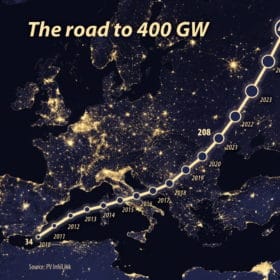
An inflection point for European solar is beginning to take shape as the industry finds itself in a period of acceleration and transformation. pv magazine’s European editors – Emiliano Bellini, Sandra Enkhardt, Gwénaelle DeBoutte, and Pilar Sánchez Molina, along with Jonathan Gifford – look at four trends shaping the market.

The Hydrogen Stream: US government wants to reduce green hydrogen cost by 80% to $1 per kilogram in one decade
Furthermore, Swiss energy company Axpo and Swedish-Swiss electrical equipment giant ABB committed to combining their technologies and skills for several projects related to green hydrogen in Italy and Germany’s gas transmission system operators Gascade and Ontras announced a plan to set up a platform for the hydrogen industry in eastern Germany, with an initial grid to cover 475 kilometers of pipelines.

‘Where appropriate, agrivoltaics can certainly be a viable and meaningful alternative to large-scale solar’
US expert in environmental and energy policy Alexis Pascaris spoke with pv magazine about opportunities and barriers associated with agrivoltaics. Agrivoltaics are a very practical and advantageous alternative to large-scale solar, specifically in places where there are land-use constraints or needs for rural economic development, she explains. Differences in costs related to ground-mounted solar can typically be attributed to the raised racking systems or additional fencing, but these upfront investments in specialized hardware are eventually recovered as agrivoltaic systems produce dual-revenue streams.

Maldives launch tender for 40 MW/40 MWh of storage
The government of the archipelago is tendering the deployment of two big batteries, with capacities of 24 MW/24 MWh and 16 MW/16 MWh, respectively, to store renewable energy for 22 islands.
