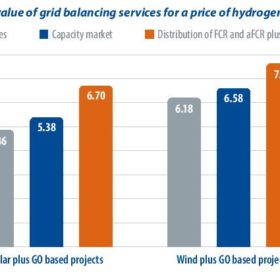
Green hydrogen: A new entrant to the energy sector
Green hydrogen can play a vital role in decarbonizing the economy and enabling countries to reach net-zero emissions. The economics of producing green hydrogen from electrolysis are maturing as developers scramble to meet expected future demand. Everoze partner Nicolas Chouleur and Neoen hydrogen expert Sacha Lepoutre discuss a case study that shows how stacking different revenue streams could improve the economics of renewable energy projects.
Construction reported underway at 1GW of wind, solar, storage projects in Inner Mongolia
Chinese renewables and gas-fired power plant developer Beijing Jingneng Clean Energy Co. announced today that it has commenced work on wind and solar projects in the autonomous region of Inner Mongolia with a combined capacity of 1GW. One of the projects is a combined solar, wind and hydrogen electrolysis project with a generation capacity of 500MW.
Rystad: Residential solar soars past C&I in 2021
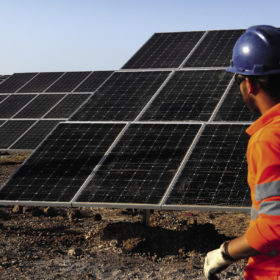
Renewable energy and battery storage has racked up another banner year in 2021, according to end-of-year analysis from Rystad Energy. While there was growth across segments, residential solar has seen the most impressive gains, surpassing the commercial and industrial (C&I) segment for the year.
Lightsource BP closes $376 million in financing, breaks ground on two massive US projects
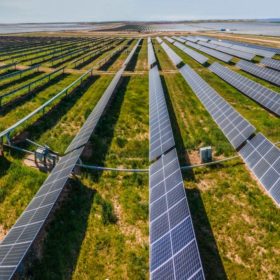
The 293MW Sun Mountain solar project, set to be located in Pueblo, Colorado, and the 173MW Bellflower solar project, set to be constructed east of Indianapolis will each be among the largest in their respective states.
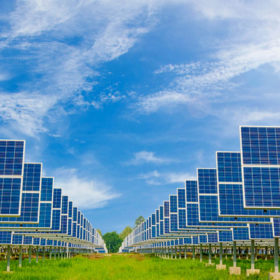
Chinese Industry Brief: Risen plans RMB44.65 billion for solar expansion along supply chain
Furthermore, speaking about its joint venture with Trina Solar for the development of 15GW of ingot manufacturing and 15GW of wafer cutting projects, Tongwei said all work will be finished and put into production in H1 2022. PV prices are also seeing declines along the solar supply chain.
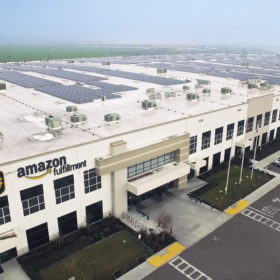
Stepping UP in 2021: #3 Sustainable electricity and corporates’ critical solar role
Despite the global Covid-19 pandemic and recession, corporate purchases of clean energy are booming. Several factors are driving this trend, including falling costs, a heightened appetite for sustainability among consumers and investors, and increased political will for net-zero development. In recognition of this, the UP Initiative spent Q3 2021 investigating sustainable electricity supply. How are PPA models evolving? What are the critical issues around residual energy? And how can greenwashing be avoided? Read on to discover more.
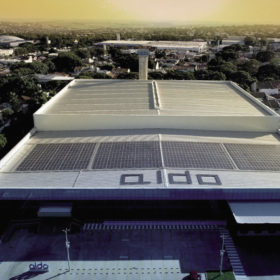
Brazil heads for a solar installation rush
Brazil’s deployment of distributed generation PV (below 5 MWp) has exploded from a total capacity of 500 MW in 2018 to 7 GW by September of this year. The trigger for this increase, alongside rocketing electricity prices, was the 2019 proposal of law 5829, writes IHS Markit analyst Angel Antonio Cancino. The proposal is expected to pass into law at the end of this year and will gradually introduce grid-access charges for residential and commercial system owners.
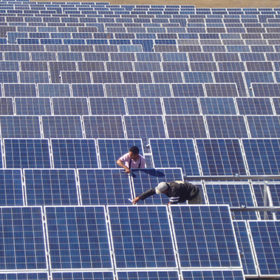
Risen Energy plans integrated PV factory run on clean energy
The Chinese PV manufacturer has unveiled ambitious plans to build a vertically integrated factory in China’s Inner Mongolia region, which will be powered by a mix of solar and wind coupled with on-site energy storage.
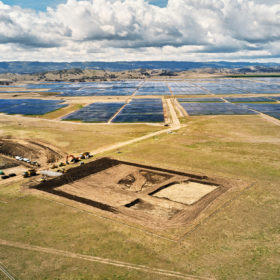
PV and energy storage expected to comprise 62% of US capacity additions 2022-23
The US is expected to add 78GW generating capacity over the next two years, 49GW of which is expected to be large-scale solar and energy storage.
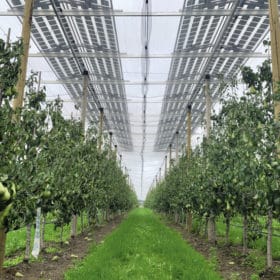
Stepping UP in 2021: #1 How agri-PV could address two of the biggest sustainability challenges of our times
2021 marked the second year of pv magazine’s UP Initiative where we shined a spotlight on sustainability in the solar industry. Over the course of 12 months, we focused on four key issues. First up was agrivoltaics – the combination of agriculture and solar energy – in recognition of this emerging market. The goal was to understand the potential benefits and economic, political, and technical challenges of such an innovative partnership. Read on to discover our coverage from this quarterly theme and watch out over the coming days for the topics of Workers’ rights, Sustainable electricity and corporates’ critical solar role, and Urban Solar.
