
Covid-19 weekly briefing: US residents ponder solar during lockdown, Aussie installers wonder what might have been and the Indian EV industry calls for help
Plus, Italian developers continue to dig deep for their health service, the pandemic piles on problems for a debt-saddled Chinese company and analysts consider whether there will be any money left for a green economic recovery after the dust settles.
Strong Q1 for First Solar, Enphase, Sunrun
U.S. residential solar installer Sunrun reported strong solar deployments and revenue to start 2020, even with orders decreasing by as much as 40% for periods in March. Micro-inverter manufacturer Enphase’s first-quarter revenues exceeded expectations as the company set an all-time gross margin record and announced plans for a new manufacturing location.
Huawei to ramp up artificial intelligence to improve solar inverters
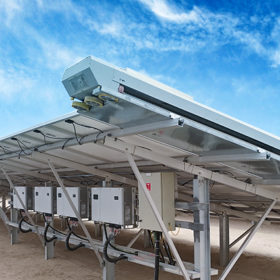
The Chinese conglomerate has revealed how it will further integrate artificial intelligence (AI) in its string devices this year. The approach includes the transformation of inverters into smart PV controllers, the development of AI inference modules and the creation of an AI training and inference platform. Machine learning will also be incorporated into operations and maintenance, grid management and PV plant design.
SolarEdge braced for Covid-19-related dip in record revenues
The Israeli inverter maker again posted a robust set of quarterly figures but is anticipating a dip in performance during the current three-month window as pandemic-driven lockdowns take effect in its markets.
Huawei, Sungrow and SMA dominate global inverter market
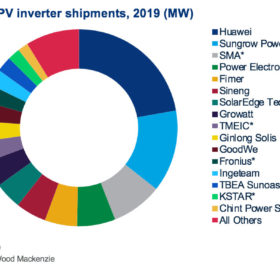
Analysis from Wood Mackenzie shows global inverter demand grew 18% last year. The ten largest inverter suppliers accounted for 76% of the global trade.
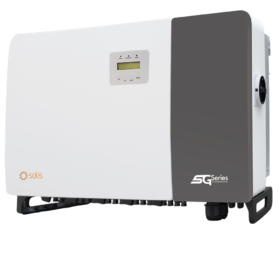
New 5G string-inverter for commercial applications from Ginlong
The Chinese manufacturer has integrated the Solis 110 kW string inverter into its 5G tech platform. The company claims the upgraded device can offer stronger system returns and a lower levelized cost of energy. The price of the Solis-110K-5G inverter is €0.035/W.
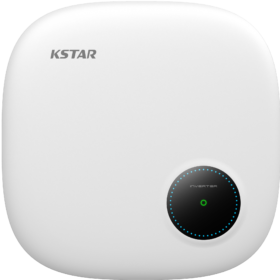
Kstar launches new inverter series for rooftop arrays
The transformer-free products have a power range of 3-6 kW and efficiency of 97.8%. The Chinese manufacturer says the devices are designed to accurately match the voltage and phase of the grid sine wave AC waveform.
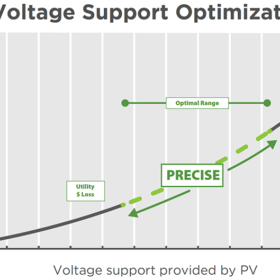
Preconfiguring and controlling inverter set-points
Researchers from the U.S. National Renewable Energy Laboratory have developed a tool to balance customer curtailment and grid stability. The “Precise” tool for utilities provides unique inverter settings tailored to each customer, with minimal investment and labor for companies that use it.
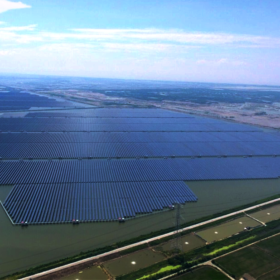
Another 120 MW of solar aquaculture in China
A 120 MW solar plant located in a fishery near Cixi, in the Chinese province of Zhejiang, was recently completed. The plant, which has secured a tariff of RMB0.95 ($0.12)/kWh, is the second phase of a 320 MW project owned by Chinese developer Hangzhou Fengling.

Solar inverters vs. cyberattacks
A U.S. research group is now developing new inverters to protect solar installations from cyberattacks. The researchers also aim to create new cybersecurity standards. Professor Alan Mantooth, the group’s research coordinator, said that inverters can be shut down if they are hacked, or contribute to grid instability and result in the overcharging of batteries, while potentially creating problems that we still don’t know how to address.
