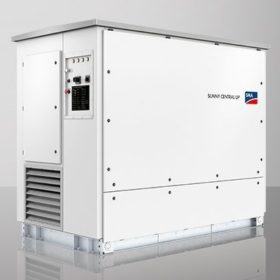
SMA presents new central inverter at REI
The German inverter giant says its latest central inverter offering has a capacity of 4.6 MW and offers the ability to connect AC and DC battery storage systems.

Emergency power supply vs. full home backup: Your questions answered
Solar battery systems should maintain power supply when the grid goes down. Right? Well, it’s not always that simple. A recent pv magazine Australia webinar, hosted in partnership with SMA, was looking into different homeowner needs and ways to install an emergency power or ‘full home backup’ system. Here are the answers to some of the webinar attendee’s questions.
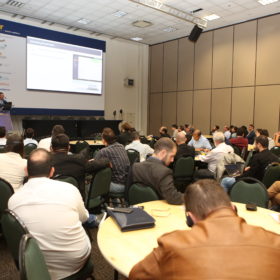
Quality Roundtable at Intersolar SA: Solar project risks in LatAm markets
At pv magazine‘s first quality roundtable in Latin America – at Intersolar South America in Sao Paulo – we were joined by international players such as JinkoSolar and DuPont, as well as public and private Latin American entities striving to bring more quality to the PV supply chain from the US-Mexico border to Tierra del Fuego.

REI 2018 opens its doors with a bang
The 12th Renewable Energy India (REI) Expo opened its doors today; the booming music and bright sunshine mirroring India’s ambitious goals to become the biggest RE market in the world. In the opening conference, the government’s commitment to renewables was underlined, while BNEF said the country will have one of the highest penetrations of solar and wind, globally, by 2050. Companies are also starting to look to India for manufacturing opportunities, although the landscape is still filled with uncertainty.
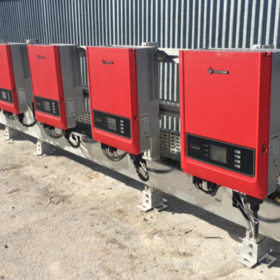
Interview: GoodWe talks IPOs, policy changes and tripling production capacity
In an interview with pv magazine, vice president of GoodWe, Ron Shen, talks about the company’s plans for Germany, Spain, Africa and India, in addition to its goal to triple production capacity to 15 GW in China. He also discusses the effect of China’s 31/5 policy change, and plans for an initial public offering (IPO).

Flex to manufacture Enphase products in Mexico
The U.S. microinverter maker has said the capacity increase will be made under its partnership with the Flex Group. It will start delivering devices produced in Mexico to the U.S. market, starting in the second quarter of 2019.

Array Changing Technologies 2018: The winners
After plenty of deliberations from the jury of independent PV industry experts assembled by pv magazine, we are pleased to announce the top innovations selected in the Array Changing Technologies 2018.
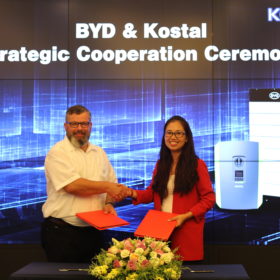
BYD, Kostal announce energy storage partnership
Following on from a partnership in 2017, Kostal and BYD are looking to further strengthen their ties under a new deal, which will see them provide storage solutions to the residential and commercial solar segments.
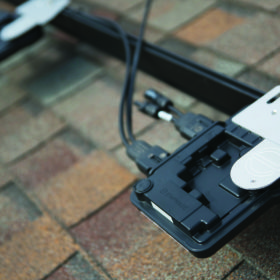
Enphase boosts confidence, touts technology during analyst day
While the microinverter maker is still the target of an aggressive short, Roth Capital Partners has reiterated its “buy” at $6.50 per share, describing the IQ8 as a “game changer”.

Japan’s PV sector should focus on future energy mix target — report
The Japanese PV industry should respond to the government’s recent decision to leave its 2030 energy mix targets unchanged by pushing for a higher share of solar in the next version of the country’s strategic energy plan, according to a new report.
