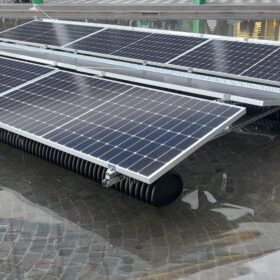
The impact of wind load effects on offshore floating photovoltaics
Researchers have investigated the aerodynamic performance of a single floating PV setup of 16 panels, as well as an array that combined 15 such setups. They found that drag coefficient distributions and wind pressure effects on PV systems vary by inlet angle. They have also identified cost-saving opportunities through material optimization.
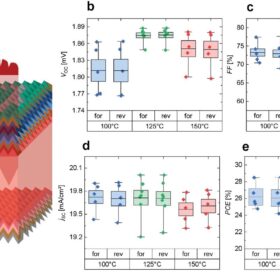
Perovskite-silicon tandem solar cell based on hole selective monolayers achieves 29.8% efficiency
Researchers from Fraunhofer ISE and KAUST built a perovskite-silicon tandem solar cell that reportedly offers improved reproducibility. The device relies on self-assembled monolayers that result in low parasitic absorption and rapid charge extraction.

Global solar module prices largely stabilize with upward momentum
In a new weekly update for pv magazine, OPIS, a Dow Jones company, provides a quick look at the main price trends in the global PV industry.

Zimbabwean telecom company opens solar-storage tender
TelOne Zimbabwe says it is seeking bids to finance and deploy solar and lithium-ion storage projects at its exchange sites.
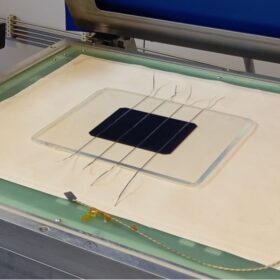
Italy’s Enea testing highly UV-transparent encapsulants
The Italian research agency has tested new UV aging tests on solar PV mini-modules made with UV-transparent polyolefins encapsulants and has found that thermal and chemical stability benefits in thermoplastic polyolefin-based (TPO) compared to EVA encapsulants.

The impact of different substrates on solar module performance
A research team has analyzed the effects of different substrates on PV module performance and has found that ground soil achieves the highest efficiency at 21.1%, followed by grass (19.6%), wood (17.95%), concrete (16.2%), roof tiles (14.3%), and iron sheets (11.5%).
Sinovoltaics updates map of North American solar supply chain
The North American manufacturing hub has added several new producers across the PV module supply chain but analysts see continued cell, wafer, and polysilicon capacity constraints. The report is based on announcements of capacities at sites in the region producing PV modules, cells, wafers, ingots, polysilicon, and metallurgical-grade silicon.

First Solar ships 14.1 GW of thin-film solar modules in 2024
First Solar delivered 14.1 GW of thin-film solar modules in 2024, driving $4.2 billion in revenue. The US cadmium telluride panel maker now faces global policy uncertainty.
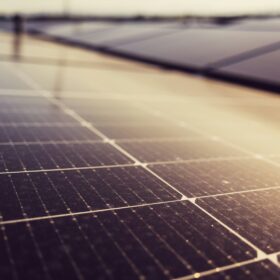
Mitigating risks in new PV technologies
The solar energy industry continues to push the boundaries of efficiency and reliability. However, as innovative photovoltaic cell and module technologies emerge, they also bring a new set of challenges in durability and performance. A new report from IEA PVPS Task 13, titled “Degradation and Failure Modes in New Photovoltaic Cell and Module Technologies,” offers a comprehensive analysis of degradation and failure mechanisms in current photovoltaic technologies.
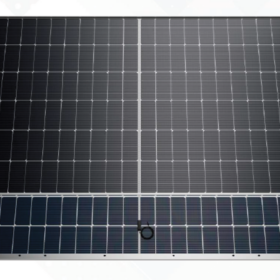
Jolywood releases 595 W bifacial TOPCon solar panel for harsh environments
The Chinese manufacturer said that its new glass-backsheet Windproof module utilizes a zinc-aluminum-magnesium surface alloy technology and a high-strength steel substrate. It features a power conversion efficiency of up to 23.03%.
