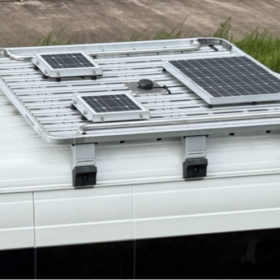
Shadow-aware route planning for vehicle-integrated photovoltaics
Japanese researchers have proposed a method for future vehicle-integrated photovoltaic route planning. It integrates environmental shading effects based on satellite and geographic information system data.
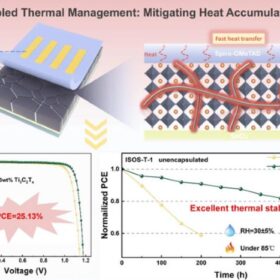
Perovksite solar cell based on MXene achieves 25.13% efficiency
A Chinese research group claims to have achieved remarkable efficiency and stability in a solar cell based on a perovskite absorber incorporating MXene, a novel type of 2D material known for its excellent conductivity, chemical stability, and thermal resilience. The device reportedly retained 80% of its initial efficiency after 500 hours.

Novel swapping technique for partially shaded PV systems
Researchers in India have developed an algorithm for quadrant swapping in PV arrays, enabling the creation of new quadrants containing either shaded or unshaded modules. The method was tested across ten shading scenarios with varying irradiation levels and demonstrated “superior” performance compared to conventional approaches.
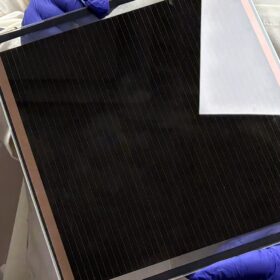
Sofab Inks achieves 22.2% efficiency in mini inverted perovskite solar panel
The U.S. startup said the 30 x 30 cm perovskite solar cell device featured its tin oxide electron transport material produced in a sheet-to-sheet slot die coating process.
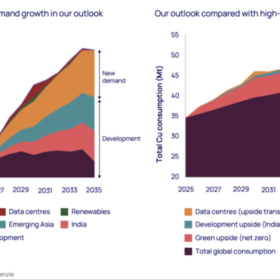
Copper demand to rise 24% by 2035, says Wood Mackenzie
Demand for copper, often considered as one of the most valuable alternatives to silver in solar manufacturing, is expected to increase by almost a quarter globally by the middle of next decade. Wood Mackenzie says the energy transition is one of four ‘disruptors’ that could cause demand to increase further.
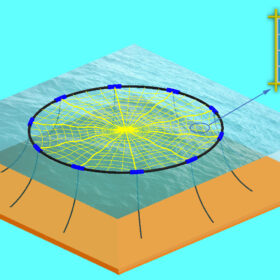
Floating photovoltaics based on spiderweb design
Scientists in the United Kingdom have developed a new web-inspired concept for floating PV farms, modeled after spider webs. The system is said to be particularly suitable for spiral and radial configurations, as well as for deployment between offshore wind farms.
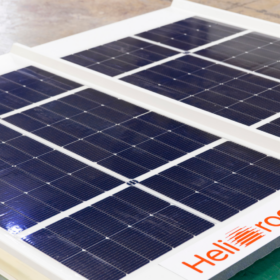
ArcelorMittal starts BIPV module production in France
ArcelorMittal has started producing its Helioroof building-integrated PV modules in France. The steelmaker says the system aims to simplify energy retrofits for commercial and industrial roofs.
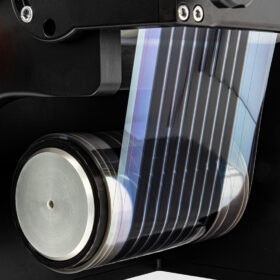
Market trust key for perovskite solar commercialization
In a new perspective paper, researchers from Dresden University of Technology and Denmark’s InfinityPV analyzed scientific research and more than 100 companies involved in organic PV and perovskite solar cell manufacturing. Their findings show that the commercialization of these technologies depends on the PV industry’s ability to increase financial transparency.

Global PV outlook clouded by policy shifts and China export risks
The global PV market faces uncertainty amid fluctuating module prices and evolving energy policies. Changes to Chinese export taxes may further raise module costs, affecting European and Asian markets.

German railway areas have 37.6 GW of solar potential
Fraunhofer Institute for Solar Energy Systems (ISE) says PV systems within 2 km of Germany’s railway substations could generate more than four times the network’s annual power demand.
