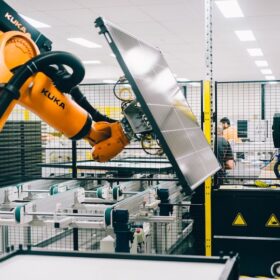
Australia announces new subsidy policy for renewable energy manufacturing
The Australian federal government has unveiled plans for a Future Made in Australia Act, proposing taxpayer-funded incentives to advance renewable energy industries, manufacturing, and infrastructure to stake the nation’s place in the global clean energy race.
New York’s open-access solar-projection tool beats commercial competition
NYSolarCast, a solar-projection tool developed by the state of New York to handle its growing base of PV facilities, demonstrated equal or superior performance than competing commercial alternatives, according to a year-long analysis.
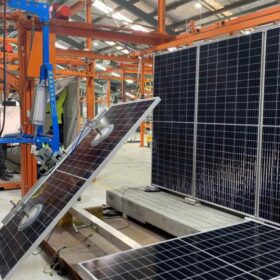
New report tips 60,000 jobs from Australian PV manufacturing industry
Building a domestic solar panel manufacturing industry based on Australian innovation could generate up to 60,000 jobs and help cement the nation’s future as a renewable energy superpower. However, access to capital and focused policies are essential if manufacturers are to reach scale where they can be internationally cost-competitive.
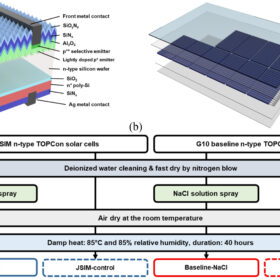
New research shows laser-assisted firing improves TOPCon solar cell reliability
Chinese manufacturer Jolywood is currently applying a laser-assisted firing process in TOPCon solar cell manufacturing that can reportedly increase contact quality and corrosion resistance, while also reducing production costs. Scientists at the University of South Wales have investigated the impact of this production process on the quality of TOPCon cells and have found it “significantly” improve their reliability.
Chinese PV Industry Brief: Seraphim begins work on 10 GW module factory
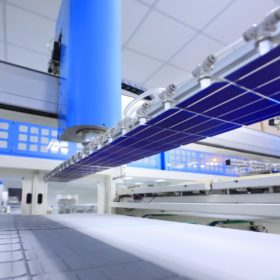
Seraphim says it will build a new 10 GW solar panel factory in two phases in Guangzhou, with an investment of CNY 6 billion ($829.6 million), while JA Solar has announced plans to construct a 5 GW panel factory in Inner Mongolia.

Key takeaways from SolarEX, Istanbul
Import duties and domestic incentives continue to shape the Turkish solar market. Despite protectionism, there was a significant Chinese presence at the SolarEX trade fair as new manufacturers rely on Asian resources.
Italian startup testing PV sleepers on railway line
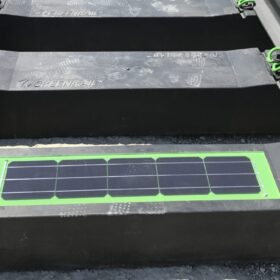
Greenrail Group has started deploying special its PV railroad-tie solution along a railway line in Emilia Romagna, Italy. The company designed the system according to the UNI 10349 standard.
Micro photovoltaic drone achieves 3.5 min autonomy
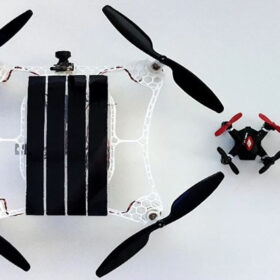
The photovoltaic micro aerial vehicle has a footprint of 0.15 m x 0.15 m and a weight of only 0.071 kg. According to its creators, it is the smallest solar-rechargeable multi-rotor ever developed to date. It uses a 22.6%-efficient solar module technology from US-based Sunpower and a 0.3 Ah storage system based on lithium polymer batteries.
Perovskite-perovskite-silicon triple-junction solar cells have technical potential to reach 44.3% efficiency
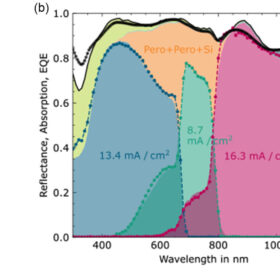
A German research team has investigated the optical properties of perovskite/perovskite/silicon triple-junction cells and has found these devices may have a practical efficiency potential of 44.3% assuming idealized electrical parameters. These cells may also potentially achieve a fill factor of 90.1%.
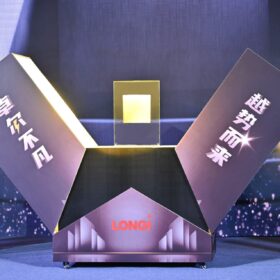
Longi releases wafers for TOPCon, heterojunction, back-contact cell tech
Chinese manufacturer Longi says that its new wafers offer a notable efficiency boost of approximately 0.1% across various cell technologies.
