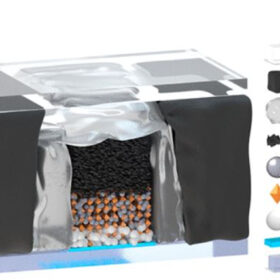
New tech to remanufacture recycled perovskite solar cells
An international research team has developed a novel way to remanufacture fully encapsulated perovskite solar cells after recycling. The researchers say the devices can achieve 88% of the original efficiency of the products.
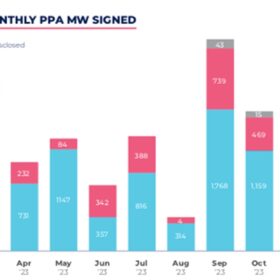
Pexapark says European developers signed 21 PPAs for 916 MW in January
Pexapark, a Swiss consulting firm, says the new year started with “robust activity” for power purchase agreements (PPAs). It says that lower power and commodity prices drove a 12.8% month-on-month decline in all tracked PPA prices.
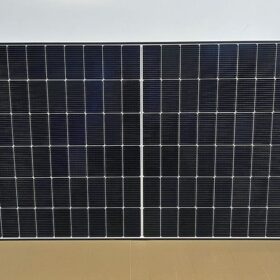
Leapton unveils 585 W TOPCon solar panel with fiberglass frame
Leapton says its new panels have a temperature coefficient of -0.30% per C and an efficiency of up to 22.65%. They come with a 30-year power output guarantee for 87.4% of the initial yield.
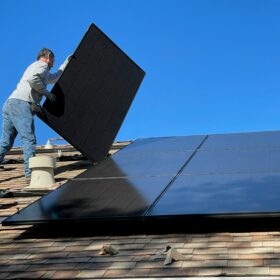
Australian PV installer owes millions to suppliers following collapse
Employees of G-Store, an Australian solar installation business, have lost their jobs and customers and suppliers are owed millions of dollars now that the company has been placed in the hands of administrators.
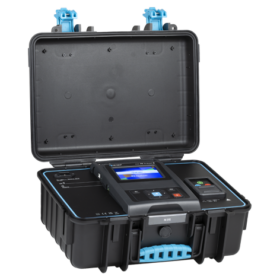
Metrel releases safety tester for 1,500 V PV installations
Metrel says its new safety-analysis tool can measure the insulation resistance of strings, the continuity of protective earth conductors, and I/U characteristics, among other features.
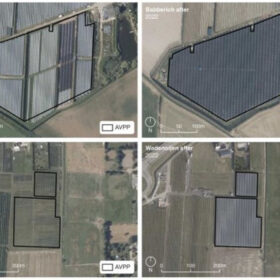
Landscape change indicators for agrivoltaics
Dutch scientists have developed new landscape change indicators (LCIs) for agrivoltaic projects. The novel methodology is meant to assist policymakers and project developers mitigate the visual and environmental impact of agrivoltaic facilities.
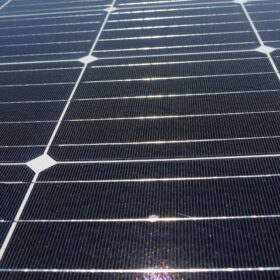
AmpIn Solar begins working on 1.3 GW solar factory in India
AmpIn Solar, a joint venture between AmpIn Energy Transition and Jupiter International Ltd, is building a new 1.3 GW solar cell and module factory in India under the government’s production-linked incentive (PLI) scheme.
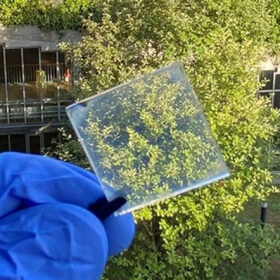
Single-junction transparent perovskite solar cell achieves record-breaking voltage of 1.78 V
A research team in Germany claims to have achieved the highest open-circuit voltage ever recorded to date for a perovskite solar cell based on hybrid methylamine lead chloride (MAPbCl3). The novel perovskite absorber was fabricated with a two-step deposition method and annealing under molecular nitrogen (N2) gas inside a glovebox.
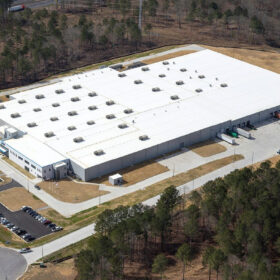
Weekend Read: Thin prospects
The production of PV ingots and wafers remains the most highly concentrated of all the production stages in the silicon solar supply chain. Yet efforts to re-establish production in Europe and the United States are not for the faint-hearted.
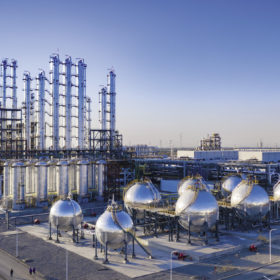
Chinese PV Industry Brief: Daqo reports revenue drop due to lower selling prices
Daqo increased polysilicon production volume in 2023 to 197,831 MT, representing a 47.8% year-over-year increase compared to 133,812 MT produced in 2022.
