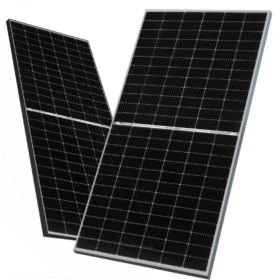
JinkoSolar achieves 25.7% efficiency for n-type TOPCon solar cell
Manufacturing giant JinkoSolar has set another world record for n-type solar cell efficiencies with its TOPCon technology, this time pushing to 25.7%. The new world record was confirmed by China’s National Institute of Metrology.
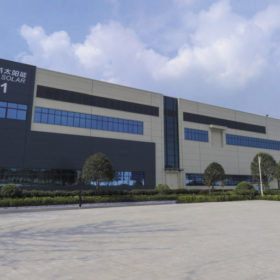
Chinese PV Industry Brief: Tongwei wants to reach 1 million MT polysilicon capacity by 2026
Tongwei also announced it wants to expand its solar cell capacity to 70 GW by the end of 2022 and 102 GW by the end of 2023.

Malaysia’s water reservoir to host 150 MW floating solar plant
The floating facility will be built by Japan’s Shizen Energy and will sell power under unspecified conditions to local utility Syarikat Air Melaka Bhd (SAMB).
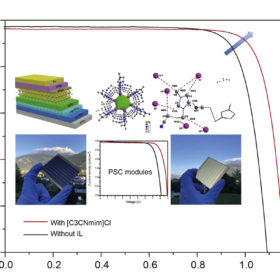
Ionic liquid-based perovskite solar cell with 22.86% efficiency
A Swiss-Japanese research group has used ionic liquids doping to improve the efficiency and stability of perovskite solar cells. Their champion device showed an open-circuit voltage of 1.16 V, a short-circuit current of 24.03 (mA cm−2), and a fill factor of 0.818. It was also able to retain around 95% of its initial efficiency after 1,000 hours of operation.
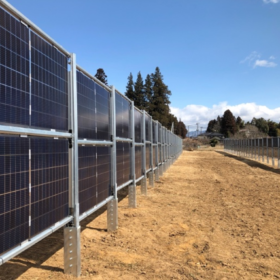
Japan’s first vertical agrivoltaic project
The facility was built with heterojunction modules and mounting systems provided by German companies Luxor Solar and Next2Sun, respectively. The distance between the panel rows ranges from 8 to 10 meters and the agricultural surface within the rows will be utilized by local livestock farmers as pasture.
Borosil Renewables to acquire Europe’s largest solar glass maker Interfloat Group
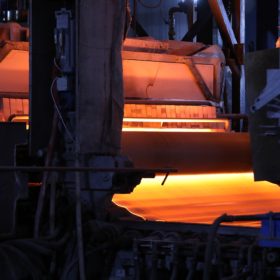
Indian group Borosil Renewables is acquiring Europe’s largest solar glass manufacturer. With major sites in Germany and Liechtenstein, Borosil plans to increase manufacturing capacity to 2,600 tonnes per day, making it possible to supply solar glass for more than 15 GW of PV modules from 2025.
Printed solar panels for Tesla’s journey around Australia
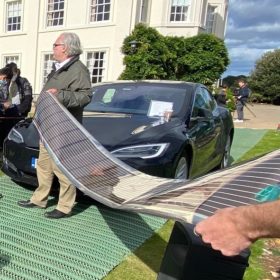
Commercially printed solar cell technology developed by the University of Newcastle is being put to the test to power an electric vehicle’s 15,097-kilometre journey around the entire coastline of Australia.
PV in the Circular Economy: Modeling tool helps predict flow of solar materials
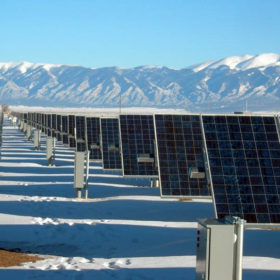
PV ICE uses the latest data from the solar industry to model the flow of PV materials over the next several decades, helping to predict the effects of different market trends, technological developments, and government policies.
Perovskite microcells for solar windows
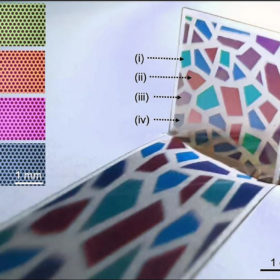
Developed by Korean scientists through a novel lift-off-based patterning approach based on swelling-induced crack propagation, the perovskite PV device achieved an open-circuit voltage of 1.16 V, a short-circuit current density of 22.5 mA/cm2, and a fill factor of 77%. With the microcells, the researchers also built a first prototype of a solar window which they claim has vivid colors and high color purity.

Growatt unveils solar rechargeable portable power station
Chinese inverter maker Growatt has launched Infinity 1500, a portable power station for off-grid applications.
