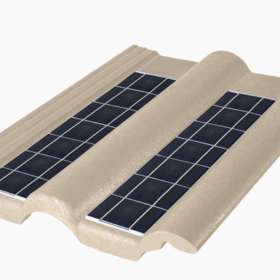
New solar tile from Brazil
Developed by Brazilian construction materials provider Eternit S.A., the tile has a nominal power of 9.1 W and an average monthly generation capacity of 1.15 kWh. It is available in five colors and two versions with a classic or reinforced design.
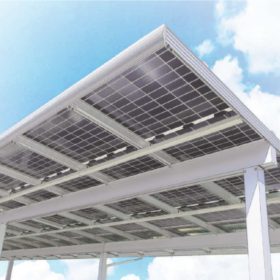
Scalable turnkey solar carport solution for commercial applications
Japanese energy company Sinanen offers a scalable solar carport that can host a minimum of four vehicles and can be deployed in the parking areas of factories and commercial buildings. The basic system is offered with a minimum capacity of 10.80 kW.
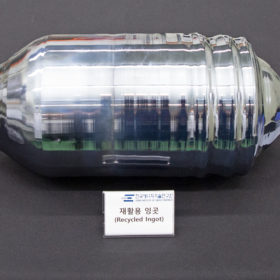
New tech to produce ultra-thin wafers with minimal silicon waste
South Korean researchers have developed a process to produce ultra-thin wafers without sacrificing any of the substrates. Their technique is based on a new approach involving the use of plasma-assisted epitaxial growth, in order to increase internal defects and porosity, rather than reduce them.
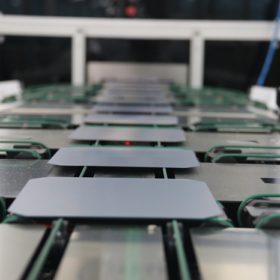
Chinese PV Industry Brief: Shuangliang secures another major wafer supply deal
The Chint group has also agreed to sell a portfolio of distributed solar projects with a capacity of 493 MW.

Indian government expands budget for PV manufacturing scheme
The Indian authorities have announced plans to provide more funding to help more manufacturers under its production-linked incentives scheme, which is designed to support gigawatt-scale manufacturing of high-efficiency solar modules.
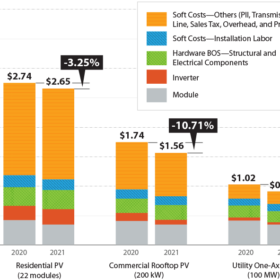
Costs falling for all PV systems in US market, says NREL
The U.S. National Renewable Energy Laboratory says in a new report that costs for all types of PV systems continue to fall, although it notes that balance-of-systems costs have increased or remained flat across sectors this year.
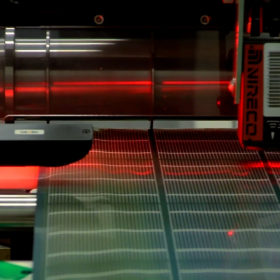
Mesoporous carbon for a 20-year stable perovskite solar cell
Scientists in Japan and Europe investigated the long-term stability of perovskite solar cells utilizing layers of mesoporous carbon, building on previous work demonstrating the strong potential of this approach. This latest work demonstrates a light-soaking effect, which allowed them to fabricate cells that retained 92% of their initial performance after 3,000 hours in damp heat conditions – which the researchers say is equivalent to 20 years in the field.
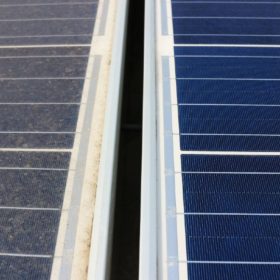
Hydrophobic anti-soiling coating for solar modules
A U.K. research group is developing an anti-soiling solution produced via a chemical process compatible with glass manufacturing. The Engineering and Physical Sciences Research Council is providing $1.6 million of funding for the project.
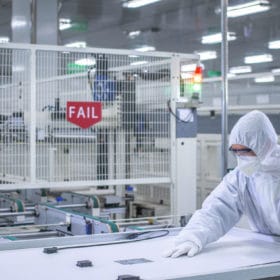
Greening solar supply chains
As solar energy experiences record growth, investors, customers, and regulators are increasingly asking for more disclosure and transparency on how solar supply chains are managed throughout product life cycles.

Indian transformer manufacturer to set up 4 GW solar fab
Shirdi Sai Electricals, an Indian transformer manufacturer and EPC contractor, has placed a $252.16 million incentive bid to set up a fully integrated, 4 GW polysilicon-to-module fab under the Indian government’s production-linked incentives scheme.
