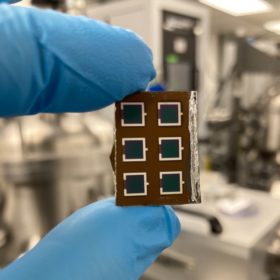
Antimony selenide solar cell with 8.5% efficiency
U.S. scientists have fabricated a cell via a two-step closed space sublimation process and by applying a seed layer to a soda-lime glass substrate coated with molybdenum via rapid thermal evaporation. They claim this facilitated the growth of a high-quality Sb2Se3 absorber layer with high crystallinity and large columnar grains.
Illustrating the n-type advantage
In a new white paper, Chinese PV manufacturer JinkoSolar demonstrates how its latest ‘Tiger Neo’ module, featuring the 182mm n-type TOPCon cells, achieves lower energy costs. Based on total project costs for various scenarios in China, the Middle East and Europe, Jinko calculates advantages arising from both the cell technology and its chosen wafer format.
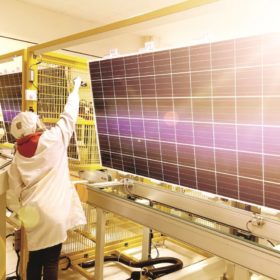
Chinese PV Industry Brief: Another manufacturer, Zhonghuan, reduces PV wafer prices
The solar manufacturer has lowered the prices of its PV wafers by up to 12.5%. In other news, Haiyuan Material (HYM) has begun deploying production lines at its 5 GW heterojunction PV module factory.

TSEC plans to raise solar cell, module production capacity to 1.5 GW
The Taiwanese solar manufacturer has raised US$22 million through a private placement of shares and will use the funds to support its solar capacity expansion plans.
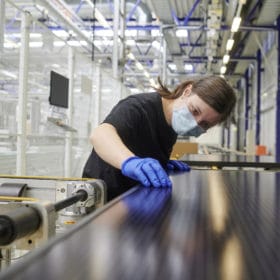
Covid-19 forces Meyer Burger to reduce solar module output, increase panel prices for 2022
An above-average employee sickness absence is forcing the Switzerland-based solar panel manufacturer to slow down production until the end of January. Meyer Burger has also informed customers that the prices for its solar modules will rise in the coming year.
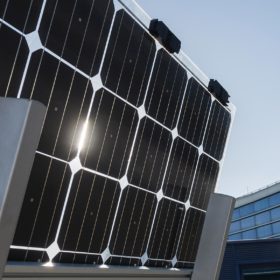
2021 and beyond: European solar manufacturing must shine again
As 2021 ends, we enter a period of reflection and preparation. The ongoing pandemic has brought supply chain disruption, while the increasingly severe effects of the climate crisis loom over us. This winter, Europeans are struggling through unprecedented energy costs, driven by extremely high global gas prices. A year of difficulties has shown that Europe, more than ever, must accelerate the deployment of renewables to provide our economy with reliable, low-cost, and clean energy.
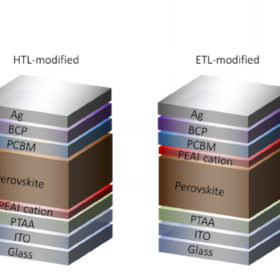
Inverted perovskite solar cell with 23.7% efficiency
A German-Italian research team has designed an inverted perovskite solar cell with a short-circuit current of 1.184 V and a remarkable fill factor of 85%. The device was built by modifying its interfaces with large organic cations.
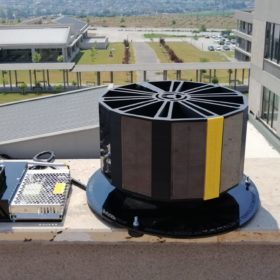
Photovoltaic rotary energy system for domestic applications, high-rise buildings
Developed by scientists in Turkey, a system prototype has operated at lower PV module temperatures and removed most of the dust accumulation. The researchers are now planning to improve the device by applying MPPT converter topologies.
Inventec Solar files for bankruptcy
Taiwanese module manufacturer Inventec Solar has accumulated about $70.2 million of debt.
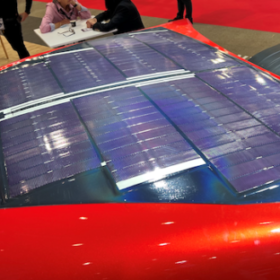
Your next package delivery could be solar powered
There is still much to debate over the benefits of moving a vehicle via solar, but the market has been getting creative and is evolving quickly.
