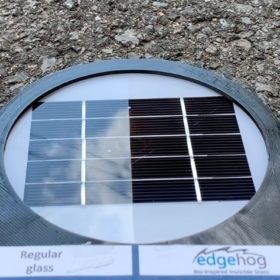
Canadian start-up secures US$2.5 million to launch omnidirectional anti-reflective glass
Edgehog secured the funds from Sustainable Development Technology Canada (SDTC). The special glass is hydrophobic and is claimed to be able to reduce the accumulation of dust and residue, thus reducing the need for maintenance.

Solar glassmaker posts another set of bumper figures
Xinyi has accelerated plans to add more furnaces this year and predicts the rebound in solar demand being driven, in part, by the desire of nations for a green recovery from Covid-19 will continue to keep supply tight.

GCL-Poly continues to ramp production capacity commitments
The poly maker is making significant investment pledges into new production lines in Sichuan and Inner Mongolia.
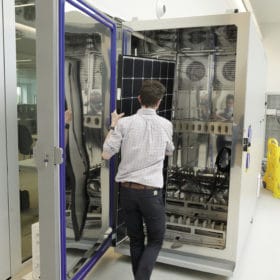
The weekend read: Bifacial adoption spurs rethink on PID
PV systems are unique among electronic devices, as they are expected to survive outdoors for at least 25 to 30 years. This makes module and system quality one of the cornerstones of guaranteed returns on investment. Potential-induced degradation (PID) is a critical failure mode with a potentially high financial impact. New research from imec and Hasselt University looks at the damaging impact that PID can have on bifacial technology, writes Michaël Daenen, a professor at EnergyVille and Hasselt University.

First Solar signs 2.4 GW deal, reports results from a “challenging” 2020
The thin-film module manufacturer achieved a turnover of $2.7 billion and a profit of $400 million last year. The company also revealed that it is evaluating further U.S. manufacturing expansion, “contingent on the right policy environment.”
Chinese PV Industry Brief: Thinner wafers, rising profits and new solar ambitions for Yunnan Province
Goodwe and Irico have both announced rising revenue and profits for the fiscal year 2020. Zhonghuan Semiconductor intends to produce thinner wafers to respond to increasing polyisilicon prices. The southwestern province of Yunnan wants to add another 15 GW of clean energy to its power generation mix.

Metal-perovskite-metal back contact solar cell with 4.31% efficiency
A numerical study by researchers at India’s Chitkara University has shown enhanced charge extraction in metal-perovskite-metal back-contact solar cell structure through electrostatic doping. The proposed design yielded a 59.4% improvement in power conversion efficiency over previously reported structures.
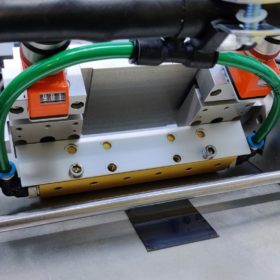
Mini perovskite solar module with 18% efficiency from CEA-INES
The mini panel has a surface of 10 cm². It was built with a manufacturing technique that is claimed to be compatible with the integration of perovskite into heterojunction silicon solar cells in tandem architecture.

MIT scientists develop perovskite solar cell with 25.2% efficiency
The US researchers claim to have achieved the remarkable result by adding a special conductive layer of tin dioxide bonded between the conductive layer and the perovskite material. They also improved the perovskite layer special additives that do not alter the material’s bandgap.
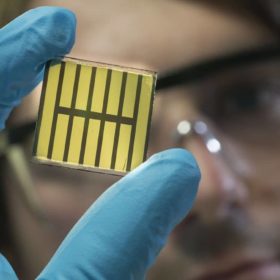
New process to assess quality of perovskite semiconductors
According to German scientists, the quality of the photoluminescence quantum yield of the perovskite layers can be reliably and precisely determined for the first time. It shows that the promising material has more potential for optimization than previously assumed.
