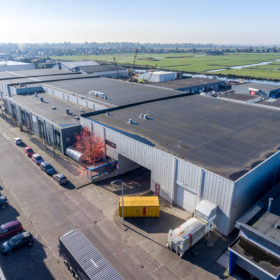
Deal reached to keep Energyra module production in the Netherlands
The Dutch PV manufacturer plans to start production this year after a last-minute rescue package arrived as the company’s equipment was being auctioned off.
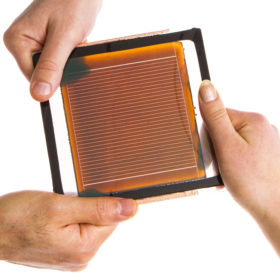
Perovskites meet the stability standard
European research group Solliance says its perovskite modules have passed three key industry standard reliability tests: Light soaking, damp heat and thermal cycling. The group said it is the first time perovskite modules of that size have achieved such results and represents a milestone in the technology’s move toward commercialization.

‘China will add 35-38 GW of solar this year’
Power generation statistics released by the National Energy Administration appear to confirm the nation added 12 GW of solar last month. China also deployed another 41 GW of polluting coal-fired power plants last year.

Lead-free soldering in modules: It can be done!
pv magazine’s UP sustainability campaign has investigated the use of lead in PV panels and found, with soldered cell interconnections in particular, viable alternatives are scarce. However, German headquartered manufacturer Opes Solutions has launched a small module for the off-grid market featuring lead-free solder, developed at the request of a customer. We caught up with Opes CEO Robert Händel for a closer look at the module and the challenges and benefits of going lead-free.

Panasonic claims 16.09% efficiency for lightweight perovskite solar module
The device has an area of 802cm² and thickness of 2mm. The manufacturer claims it improved module performance through an inkjet coating method and a reduction in weight by using thin glass substrates.

Breaking news: Zhonghuan Semiconductor up for sale
The body responsible for state-owned assets in the Chinese port city of Tianjin has approved plans to sell all or part of the solar manufacturer to outside investors – although the rumored beneficiary is thought to be partially state-owned itself.
China holds firm on strategy to build self-sufficient domestic polysilicon industry
The Chinese government will extend duties on U.S. and South Korean polysilicon for another five years from today despite committing to buy $200 billion more American goods and services in the trade deal signed on Wednesday. Poly manufacturer REC Silicon says it expects polysilicon to form part of that trade agreement.
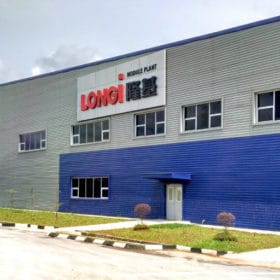
Longi claims 22.38% efficiency world record for PERC mono panel
The Chinese manufacturer said the result was confirmed by Germany’s TÜV Rheinland. The achievement beats the company’s previous record of 21.65%, set last month.
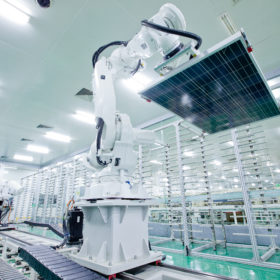
Jinko claims two more efficiency records for bifacial panels
The Chinese manufacturer has achieved conversion efficiencies of 21.82% and 22.49% for its p-type PERC and n-type HOT bifacial panels, respectively. The results were confirmed by Germany’s TÜV Rheinland.

Solargiga hits 10% revenue rise – on back of 48% more shipments
The Chinese manufacturer had to ship a lot more ingots, wafers, cells and modules to secure a modest rise in returns, according to its unaudited 2019 figures.
