
Main shareholder of Chinese module maker ET Solar files for bankruptcy
The move, by Taitong Industry Ltd, will come as a fresh blow to the Chinese module manufacturer, which twice failed to go public – in the U.S. and China – and whose project development business suffered a battering in China when Beijing reined in subsidies in 2018.

Imec: Perovskite cells can pass the IEC tests in 2020
In 2020, perovskite cells could pass the IEC tests intended for the standardization of solar modules, and in 2022, they could even be mass-produced. In an interview with pv magazine, Tom Aernouts explains the status of work on the new PV technology. He is a research and development manager for thin film photovoltaics at the Belgian research institute Imec.
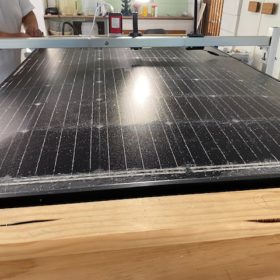
Solarwatt’s Vision glass-glass PV passes Australian cyclone testing
Solarwatt’s Vision glass-glass solar PV modules have pushed the technology’s resilience even further after passing cyclone testing in Darwin, Australia.

The panel in red
Italian manufacturer Sunerg has developed a solar module for BIPV applications which is said to offer a wide range of options to better match the architectural vision and the design of a building. The 275 W monocrystalline PERC panel is available in mahogany brown, reddish brown, bottle green and black-grey.
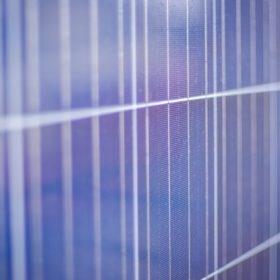
Getting the right module temperature with thermography
Researchers from Hungary have analyzed the thermal behavior of different types of PV module via thermography, and claim to have shown that theoretical models are insufficient to measure the maximum, minimum, and average temperatures of the panels. According to their analysis, glass-glass modules without frame showed the highest temperatures, while the lowest temperatures were measured for polycrystalline glass-backsheet panels with frame.

A new manufacturing process for cheaper CdTe panels
US researchers have unvelied a new manufacturing process to produce cadmium telluride (CdTe) PV panels, which they claim is 45% cheaper than current industry standards. The technique relies on the use of a high-pressure Bridgman furnace, which is a kind of industrial furnace utilized for crystal growth and directional solidification of polycrystalline ingots.
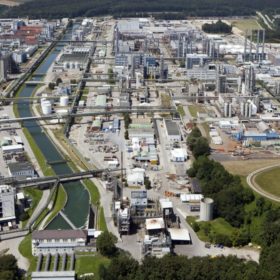
Wacker reports strong operating loss for 2019 due to polysilicon business
The German polysilicon manufacturer said results for the past financial year are in line with its expectations. However, falling sales and earnings were also reported. The company blamed low prices for polysilicon for last year’s performance.
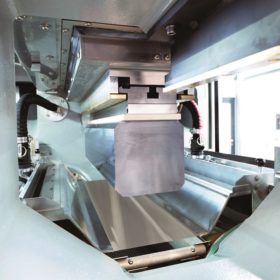
MIT researchers put slimmer silicon back on the table
With solar grade polysilicon prices having plummeted in recent years, cutting down on consumption of the material has not been a priority. But strategies exist and significant savings can be made through deploying thinner wafers that use less silicon, insists a new paper published by MIT and NREL. And as manufacturers are increasingly hitting dead ends on other routes to cost reduction, this option could be back on the table for many.
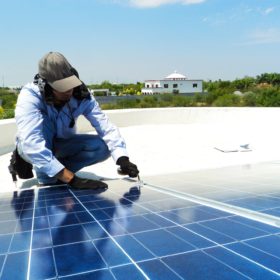
A new technique to get the right angular-tilt
UK scientists are proposing a new approach to calculating the optimum angular-tilt of PV panels for a planar surface at a particular site. In their view, the new technique may unlock innovative yield optimization methods for the installation of PV systems.
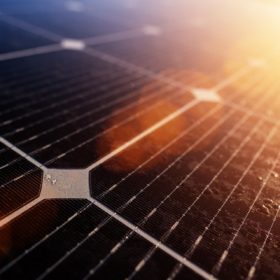
Raising the efficiency of polycrystalline cells with new luminescent EVA film
Chinese researchers have developed a pure EVA film, which they claim can enhance the conversion efficiency of conventional crystalline solar cells by around 0.50%. The film is able to convert UV light into strong visible light.
