
China walks away from state bail-out of GCL solar project business
The proposed acquisition of a controlling stake in the heavily-indebted PV project business of solar manufacturer GCL-Poly has fallen through, with state-owned China Hua Neng now proposing to cherry-pick the more attractive assets from the unit’s 7 GW portfolio.
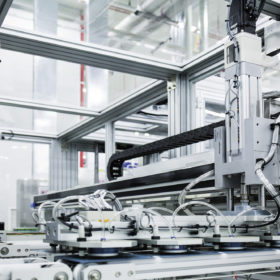
South Korea’s roadmap to drive down solar costs
The government has unveiled a plan to help the PV industry reduce the cost of solar panels from around $0.23/W to $0.10/W by 2030. The plan also aims to reach module efficiencies of around 24% – up to 35% for multi-junction cells – by the end of the next decade.
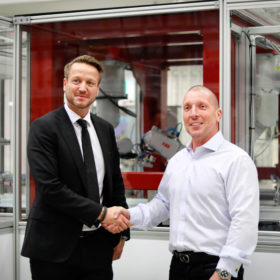
Exeger and ABB to build ‘light harvesting material’ fab in Sweden
Swedish company Exeger says the dye-sensitized ‘light-harvesting material’ it will produce at its facility will generate enough power to prevent the need to recharge portable electronic devices, lengthening battery lifespan perhaps indefinitely.

Chinese module makers land another two big overseas orders
GCL and Canadian Solar provide further proof of the solar boom that is gathering pace around the world even as attention focuses on the Chinese market.
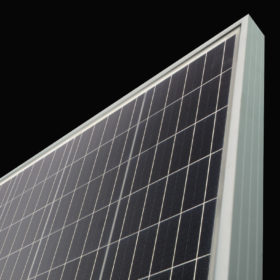
Chinese recovery will begin before year-end, according to Jinko
The Shanghai solar manufacturer has revealed another set of record-breaking quarterly figures and says it will shift 18-20 GW of modules in 2020, en route to generating revenues of $1.17-1.23 billion.

Bangladesh sets solar import standards
Complaints about sub-standard, cheap PV imports from China – and notably, India – have been heeded by Dhaka, which has issued a requirement for modules, inverters, charge controllers and batteries to attain IEC electrical standards.
Solar will power ahead to offer 20% more output for 25% lower module costs within 15 months
PV industry veteran Karl-Heinz Remmers recalls the trajectory of solar power this decade and predicts stronger than expected development for the ten years ahead.
Indian manufacturing-linked solar tender now reportedly oversubscribed
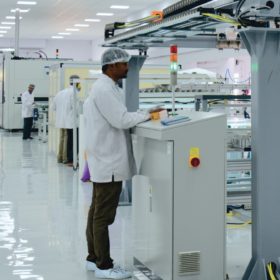
A new series of tweaks by Solar Energy Corp. of India appear to have paid off, as the organization’s ambitious, manufacturing-linked 7 GW solar tender has been oversubscribed by 1 GW.
The weekend read: A responsible compromise?
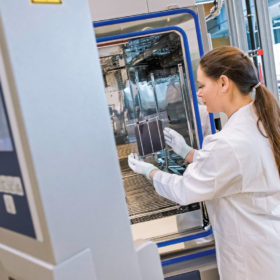
Toxicologists are struggling to follow the pace at which perovskite solar cells race from laboratory test benches to factory production lines. While researchers continue to assess the health and safety risks stemming from the lead used at the core of these new materials, the startups commercializing them argue that established encapsulation techniques and sound recycling schemes are enough to safety-proof their potentially disruptive technology and offset broader environmental threats.
Troubled Indian manufacturing-linked solar tender now reportedly oversubscribed
A series of new amendments by the Solar Energy Corporation of India appear to have paid off, as the organization’s ambitious manufacturing-linked solar tender has reportedly ended up oversubscribed by 1 GW – of the capacity offered as an incentive at least.
