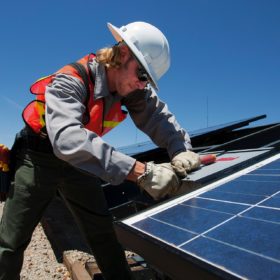
Solar panel demand expected to reach 125.5 GW in 2019, TrendForce says
According to the Taiwanese market research company, PV panel demand will increase by 16% over 2018 shipments. TrendForce also believes this growth trend will continue in 2020.

ClearVue inks solar strip module supply deal with BeyondPV
Western Australia-based solar glass developer ClearVue has signed a deal with Taiwanese thin-film solar module manufacturer BeyondPV to set up a dedicated production line for solar strip modules at its production facility in the city of Tainan.

REC Silicon lays off 100 workers at U.S. facility
Norwegian headquartered polysilicon manufacturer REC Silicon has announced that it will lay off another 100 workers at its Moses Lake facility in the western United States, as the factory heads into long term shutdown.
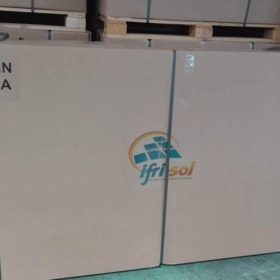
Tunisian module maker Ifrisol to increase capacity to 750 MW
The manufacturer plans to add 350 MW of manufacturing capacity at its two sites in Tunisia by next year. The ramping up is due to new orders from India and other foreign markets.

Grid data transparency vital to making the case for renewables in Vietnam
With a glut of solar capacity having come online this year, cheaper financing would help keep some of that momentum but policymakers cannot be persuaded of the economic benefits of clean energy unless state-owned utility EVN opens up.

Has solar lost its sheen for India’s EV push?
While the nation’s recent Union budget announced steps to create an electric vehicle market, the solar sector still has issues that have not been addressed.

Miasolé sets new flexible CIGS efficiency record
U.S. based Hanergy subsidiary Miasolé has achieved a record 17.44% conversion efficiency for a large area flexible CIGS module. The record has been confirmed by the Fraunhofer Institute for Solar Energy Systems.

German PV equipment suppliers export 99% of their products
First-quarter figures from German engineering association the VDMA showed that, while orders picked up after a slow end to last year, almost all PV production equipment produced in the country is shipped abroad, with China the leading destination.
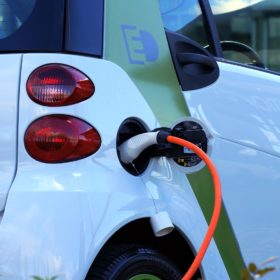
Indian ministry calls for EV manufacturing equivalent of Detroit
The nation’s annual Economic Survey placed EVs at the heart of India’s decarbonization and called for an industrial hub where electric vehicles and the batteries to run them could be manufactured.

Unlocking lithium metal’s stored potential
Several new concepts in lithium-ion storage technology have the potential to greatly the increase the energy capacity of batteries. Among them are lithium metal anodes, which could potentially increase energy density by more than 50%. With a newly optimized electrolyte, scientists at the University of California, San Diego have taken another step toward making the idea a commercial reality.
