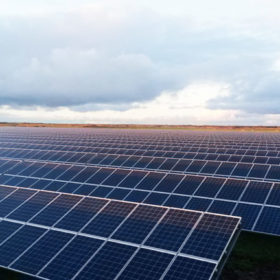
2019 PV installations to hit 123 GW, global balance shifting, says IHS Markit
More predictions from IHS Markit reveal that 123 GW of solar PV installations are expected in 2019 – up 18% on the capacity additions expected this year. It also sees a market shift away from China, with two thirds of capacity located elsewhere. The overcapacity situation is also expected to ease.
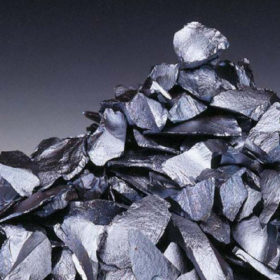
Daqo relentlessly increases polysilicon output
Chinese polysilicon maker Daqo New Energy today announced it has raised its production capacity to 30,000 MT, with a further 5,000 to follow within six months, and 35,000 on top of that by the end of March 2020.

Wacker Chemie reaches agreement with Yingli over poly supply deals
If the German polysilicon manufacturer is the ‘Supplier A’ referred to in the Chinese panel maker’s annual report, Wacker has negotiated a near $33 million settlement from arbitration. As part of the settlement, Wacker will continue to supply its counterpart with poly up to 2028.
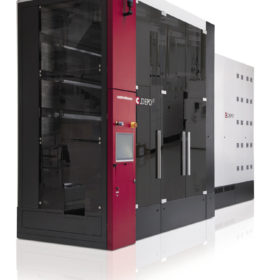
The weekend read: TOPCon boosts demand for EU equipment
Photovoltaic manufacturers in Asia are importing deposition reactors from the EU to test the latest word in silicon solar cell passivation. Two thin buffer layers sandwiched between silicon wafers and metal contacts are increasing the efficiency of conventional solar cells and setting new records. Equipment suppliers expect the technology to spread through the industry and boost their bottom line.
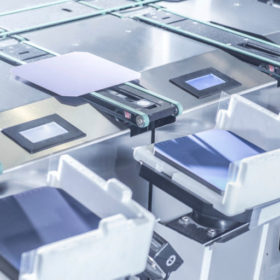
Meyer Burger picks up 600 MW heterojunction equipment order
Swiss equipment supplier Meyer Burger has received a CHF 74 million (US$74.4 million) order for a 600 MW production line combining heterojunction and smart wire technologies. The order was placed by an unnamed manufacturer, with the line expected to begin cell and module production in the second half of 2019.
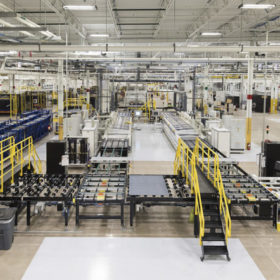
First Solar sees a doubling coming in 2019
The thin film PV maker projects 5.4 to 5.6 GW of module shipments next year, more than double its current projected 2018 volumes of 2.6 to 2.7 GW.
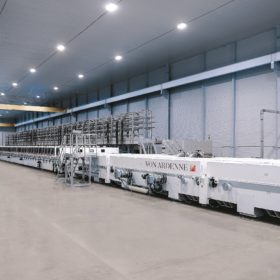
German equipment suppliers report ‘strong’ bookings for cell, thin film segments
In its Q3 2018 report, VDMA finds that German PV equipment providers are continuing to enjoy much improved fortunes compared to the previous year. Solar cell and thin film equipment suppliers account for the vast majority of bookings.
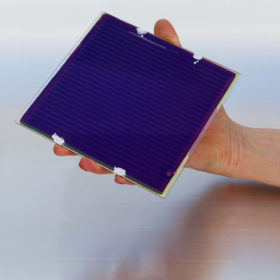
Greatcell Solar enters administration
Australia-based perovskite solar cell specialist Greatcell Solar has failed to secure refinancing for its activities and has been forced to appoint administrators. The company lays the blame at the federal government’s door, pointing to the R&D rebate changes and policy settings that are unsupportive of renewable energy investment as the reasons behind its downfall.
Sentis Capital urges Meyer Burger to establish GW-scale HJT production
Meyer Burger’s largest single shareholder has requested the company change strategy. Sentis Capital has urged the Swiss technology company’s board to raise sufficient capital for it to set up its own GW-sized production facility for its heterojunction and tandem cell PV technology. Meyer Burger has responded that it is view of only one shareholder.
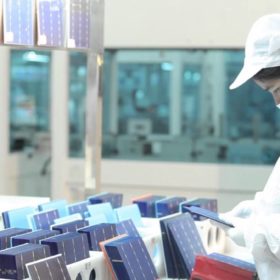
Global-PV market: demand increasing – prices largely stable
According to EnergyTrend and PV Info Link, the downward spiral of prices along the PV value chain has come to a halt. Nonetheless, by bringing together the two pieces of recent market analysis, regional and value chain variations can be observed.
