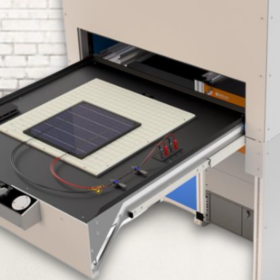
Wavelabs unveils tester for mini perovskite solar modules
The Germany-based testing equipment manufacturer has launched mini-module testing equipment targeted at researchers working on scaling perovskite solar cell technology, thin film devices, and wafer-based PV.

Chinese PV Industry Brief: Tongwei, GoodWe post 2024 losses
Tongwei says it recorded a $969 million net loss for fiscal 2024, while GoodWe posted an $85 million loss and Ginlong’s net profit fell 11.3% to $95 million.

Harnessing the power of agrivoltaics: the future of sustainable land use
In its latest monthly column for pv magazine, IEA PVPS provides a comprehensive overview of the recently released edition of the “Dual Land Use for Agriculture and Solar Power Production: Overview and Performance of Agrivoltaic Systems” report. The 91-page handbook was developed by IEA PVPS Task 13.

PV outperforms wind, piezoelectric energy in street lighting
Scientists in Thailand have assessed which technology between PV, wind, or piezoelectric energy is better for powering street lighting and have found solar is the winning tech, as it proved both economically and technologically feasible.

How to find optimum PV placement in mountain regions
Switzerland’s WSL Institute for Snow and Avalanche Research (SLF) is investigating how solar yield can be optimized in snow-covered terrain. It is envisaged the results will help to place PV systems on mountains so they make use of light that is reflected from neighbouring slopes.
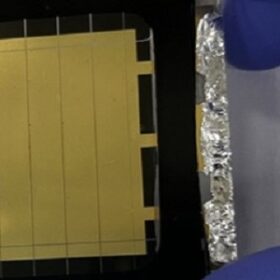
Inverted perovskite solar cell based on ionic salt achieves 26% efficiency
An international team led by the U.S. National Renewable Energy Laboratory (NREL) has used ionic salt for the electron transport layer of a perovskite solar cell to improve device stability and performance. Test results showed a 26% power conversion efficiency with 2% degradation after 2,100 hours of 1-sun operation at 65 C.

Solar technologies at crossroads
Experts set to speak at the NetZero Milan Expo-Summit 2025 on May 15 have told pv magazine that tunnel oxide passivated contact (TOPCon) will remain the dominant cell technology in the near term due to ongoing advancements, despite rising competition from back-contact and heterojunction technologies.

Chinese PV Industry Brief: Longi ships 17 GW of back-contact modules in 2024
Longi says it shipped 17 GW of back-contact modules in 2024 and cut its net loss to CNY 8.62 billion ($1.18 billion), citing tighter inventory control, cost reductions, and higher investment returns.
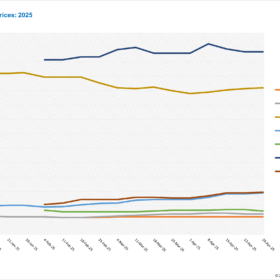
China module prices bearish, U.S. prices rise on tariff policies
In a new weekly update for pv magazine, OPIS, a Dow Jones company, reports that TOPCon modules from China held steady at between $0.085-0.090/W. It also reveals that Europe prices for TOPCon modules of over 450 W rose by 0.96%, assessed at €0.105/W.
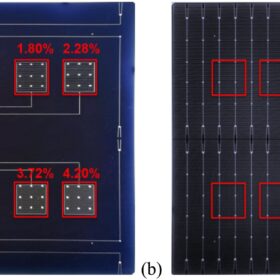
Jolywood’s laser-assisted firing process increases TOPCon solar cell efficiency by 0.6%, says UNSW research
New research from the University of New South Wales have found that the Special Injected Metallization (JSIM) technique developed by Chinese manufacturer Jolywood can considerably increase TOPCon solar cell efficiency. The scientists described precisely how laser-assisted firing enhances cell performance, reportedly filling critical gaps in industrial TOPCon cell optimization.
