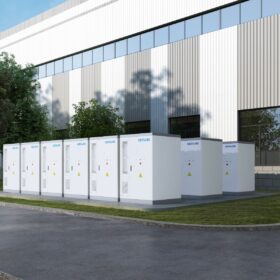
Weiheng Ecactus releases 233 kWh all-in-one battery system
Weiheng Ecactus has unveiled its new Tianwu battery system, with 233 kWh of capacity and 100 kW of output, giving users the flexibility to connect up to 10 units in parallel.

EU launches first green hydrogen auction with ceiling price of €4.50/kg
The European Union has launched its first green hydrogen auction with a maximum price of €4.50 ($4.91)/kg. The approved projects will receive subsidies for a decade, alongside revenue from hydrogen sales, and must start production within the next five years.
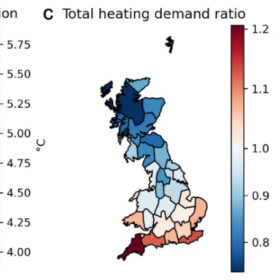
High-resolution model to identify hourly usage patterns of residential heat pumps
Developed by scientists from the UK and Spain, the new model uses high spatiotemporal resolution weather data and data from heat pump field trials. It finds “significant regional differences” compared to a British nation-wide estimation.
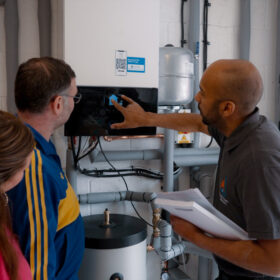
EDF acquires CB Heating
EDF has purchased UK heat pump installer CB Heating for an undisclosed sum.
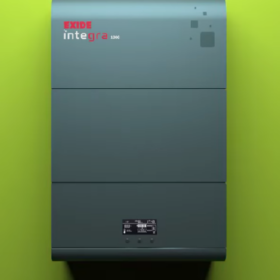
New wall-mount lithium battery inverters from India
Exide, an Indian manufacturer, has entered the lithium-ion home power backup market with wall-mount lithium battery inverters ranging in size from 450 W to 720 W.

Israel to build energy communities in villages destroyed by Hamas
Israel’s Ministry of Energy and Infrastructure says it is currently developing a multi-year program for communities attacked by Hamas on Oct. 7. It aims to deploy 5 GW of energy in the destroyed areas, once residents return.

Australia targets 32 GW of renewables with investment scheme
Australian Energy Minister Chris Bowen has announced a major expansion of the Commonwealth-funded Capacity Investment Scheme that will now target 32 GW of renewable generation and storage capacity to support the nation’s clean energy transition.
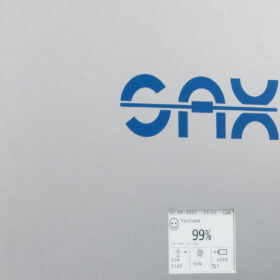
Sax Power unveils plug-in 5.8 kWh lithium iron phosphate battery
Sax Power has developed a 5.8 kWh lithium iron phosphate battery, priced at €4,957 ($5,403) for end customers, with a smart meter for precise electricity delivery.
Dynamic allocations increase financial savings in energy communities
A global research group has compared static, customized dynamic, and dynamic-by-default energy allocations at a collective self-consumption project in France. They have found that dynamic customization performs better due to tax benefits.

PV-driven Carnot batteries may help convert coal power plants into renewable energy facilities
Danish researchers investigated how solar-powered Carnot batteries could be integrated into decommissioned coal power plants to produce clean energy. They found that a 300 MW retrofitted plant coal plant with 1.37 GWh of thermal storage capacity has the potential for annual net power production of up to 1,150 GWh for 12 h storage at a levelized cost of energy of €88.09 ($95.97)/MWh.
