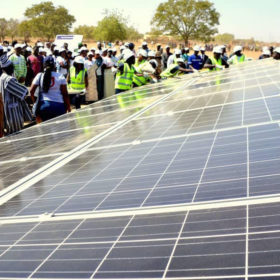
Work begins on 30 MW solar plant in Burkina Faso
Electricity generated by the facility will be sold at $0.08/kWh to national utility Sonabel. Burkina Faso recently adopted a solar-oriented energy policy.

Pakistan Post wants solar
The postal operator, which is present in 12,000 locations nationwide, wants PV facilities to power its operations. Bidders have until February 20 to deliver on a call for expressions of interest and pre-qualify for the tender.

Canadian 400 MWac merchant solar plant secures financing
The project will operate at a profit in part thanks to an emissions scheme introduced by the province of Alberta on January 1. The plant will be able to sell its carbon certificates.
Coronavirus could cause solar panel price spike
The coronavirus outbreak in China could raise solar module prices in the near term as manufacturers have already begun experiencing wafer and solar glass shortages. Production rates are also being affected by an extended new year holiday introduced by the authorities as a measure to deal with the virus, and the requirement workers from infected areas quarantine themselves for two weeks.

Bangladesh prepares to tender solar rooftops on public buildings
The government will reportedly be ready to tender contracts to install rooftop PV on its buildings across eight divisions of the nation in as little as three months’ time.
More than 5,000 tons of modules collected for recycling in France
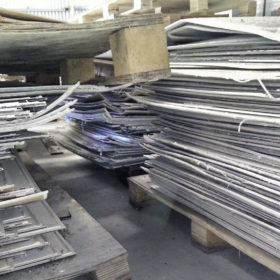
PV Cycle has said it collected more than 280,000 solar panels at the end of their lifecycle in France last year, including 200 tons from the nation’s overseas territories.

India concludes world’s largest renewables-plus-storage tender at $0.0566595/kWh
Pumped hydro and battery projects, coupled with renewables, offer the world’s lowest peak clean electricity tariff. The tender, which received bids for for 1.62 GW of capacity against the 1.2 GW sought, saw Greenko secure 900 MW of pumped storage capacity and Renew Power 300 MW of battery storage.

German coal mines could host 3 GW of floating PV
Research institute the Fraunhofer ISE has estimated the technical potential of floating PV at mining sites in Germany at around 56 GW. With floating projects 10-15% more costly than land-based alternatives, researchers have called for further incentives, such as the staging of ‘innovation tenders’.
Change at the top of state grid could have ramifications for Chinese solar
The world’s largest utility has looked outside the energy industry for its new head for the first time in its history, apparently signalling a lack of patience in Beijing with the slow pace of implementing a lower electricity price and of guaranteeing purchase of all clean power generated in the nation.

Uzbekistan opens tendering process for 200 MW solar park
The project is part of the 1 GW solar program developed by the government with the support of the Asian Development Bank. The solar park will be in the Surkhandarya province, in the far southeast of the country.
