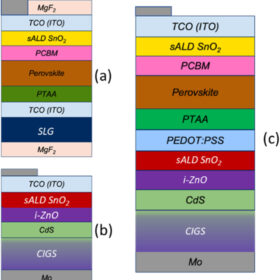
Two-terminal perovskite-CIGS tandem solar cells have technical potential to achieve 26.69% efficiency
A Dutch and U.S. research team performed optical and electrical simulations to understand loss mechanisms in two terminal (2T) tandem cells based on perovskite and commercially available copper-indium-gallium-selenide (CIGS) cells, and subsequently established a roadmap to increase efficiency via four key modifications.

China’s solar dominance not an issue
In a new monthly column for pv magazine, the International Solar Energy Society (ISES) explains why potential trade disruptions in the global PV supply chain are substantially different from those related to coal, oil and gas.

New soiling detection method based on drones, AI, image processing
Developed by scientists in China, the proposed approach uses mathematical morphologies for image processing, such as image enhancement, sharpening, filtering, and closing operations. It also uses image histogram equalization and edge detection, among other methods, to find the soiled spot.

How long do residential solar panels last?
Multiple factors affect the productive lifespan of a residential solar panel. In the first part of this series, we look at the solar panels themselves.
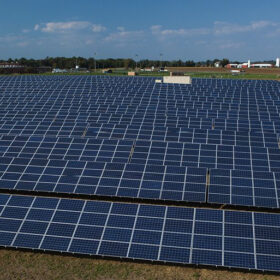
Trina Solar probing potential breaches of TOPCon patents
Trina Solar says it has started evaluating potential violations of some of its patents for tunnel oxide passivated contact (TOPCon) tech. One of the patents focuses on the number of busbars and their width in TOPCon solar panels.

Israel’s N2OFF enters solar business
Agri-food tech specialist N2OFF says it has entered the PV business by lending €375,000 ($407,000) to Israeli PV developer Solterra Renewable Energy. The loan is part of a larger €500,000 agreement, with the remaining €125,000 to come from other parties.
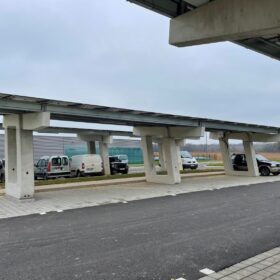
Mecosun offers concrete solar carport
Mecosun says it has introduced a new solar carport in three formats, using low-carbon concrete and an embedded module mounting solution.

Yield modeling platform for large-scale solar
Australian software developer PV Lighthouse has secured almost AUD 1.97 million ($1.32 million) to drive development of its SunSolve Yield advanced simulation engine, which is designed to improve yield forecasting for utility-scale solar projects.

EneCoat to accelerate perovskite PV production
EneCoat Technologies, a Japanese solar perovskite developer, has raised JPY 5.5 billion ($35 million) from new and existing investors to finance new collaborations based on its low-temperature production process.
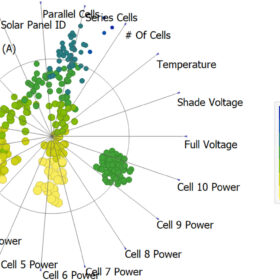
k-Nearest Neighbors algorithm for PV power forecasting
Scientists in Iraq used a k-Nearest Neighbors algorithm to evaluate the operational status of PV modules under various conditions, including partial shading, open circuit, and short circuit scenarios. They found that the overall performance of the model in predicting power output was “notably accurate.”
