
MIT scientists develop solar desalinator with high water output
Massachusetts Institute of Technology (MIT) researchers have developed a solar desalinator with high water output, via a multi-stage system of evaporators and condensers. It offers cost-effective solar desalination, making solar-produced drinking water cheaper than tap water for the first time.
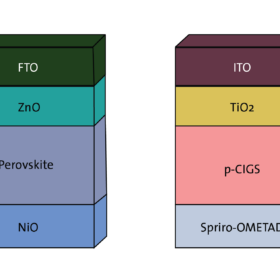
Novel perovskite/CIGS tandem PV cell design promises 38.39% efficiency
A research team in Bangladesh has simulated a perovskite-CIGS PV device that can reportedly achieve a remarkable tandem cell voltage of 2.48 V. The proposed method is also applicable for tandem cells composed of other materials.
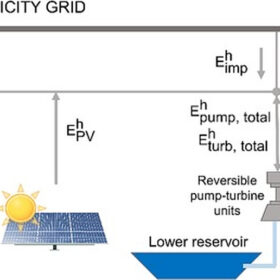
Techno-economic dispatch model to combine pumped hydro with solar, wind power
A research team in Spain has developed an hourly mathematical model that reportedly allows for the optimal management of grid-connected renewable generation facilities and pumped hydro-energy storage with reversible pump turbine. The scientists tested the model on a potential pumped hydro-solar-wind complex in northern Spain and found that the combination of the three technologies may achieve considerable savings.

The Hydrogen Stream: Researchers developing cheap hydrogen storage
As the Oxford Institute for Energy Studies underlines the delays in hydrogen storage investments, a group of researchers have developed a cost-effective material to absorb hydrogen at non-cryogenic temperatures, which they consider optimal for fuel cell storage systems.

‘We want the heat pump industry to stay in Europe,’ says EU Energy Commissioner
EU Energy Commissioner Kadri Simson, speaking at the European Heat Pump Association’s (EHPA) Heat Pump Forum this week, has reaffirmed the European Union’s commitment to decarbonizing heat.
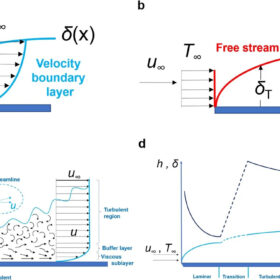
Wind speed increases could cause PV yield losses
A Spanish research group says air flux variations over different parts of solar plants could also lead to mismatch losses. Past. studies have only looked at the benefits of high wind speed on PV arrays, which enhances module cooling.

EV sharing to provide stationary storage services via V2G tech
We Drive Solar and MyWheels have announced plans to transform the Dutch city of Utrecht into the world’s first municipality with a “neighborhood battery on wheels.” The system will feature 25 Ioniq 5 vehicles equipped with vehicle-to-grid (V2G) tech from Hyundai Motor.

October 14 eclipse to cost US states up to 17% of daily solar generation
In a new weekly update for pv magazine, Solcast, a DNV company, reports that North and South America are set to experience an annular eclipse on October 14, which means that some regions could lose a significant portion of their daily solar energy production. The path of the eclipse tracks across the southwestern United States, from Oregon to Texas, before continuing through Mexico, Central America and ending in Brazil, though impacts will be seen across all of the contiguous US and the top of South America.

TotalEnergies acquires French agrivoltaics specialist Ombrea
TotalEnergies has become the sole shareholder of French agrivoltaics specialist Ombrea, in a transaction that builds upon the partnership they started in 2019.
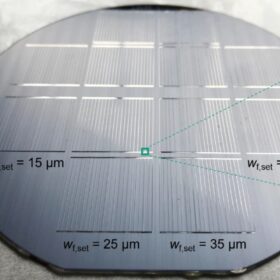
III–V triple-junction solar cell with mask, plate front metallization achieves 31.6 % efficiency
Fraunhofer ISE researchers utilized a new front metallization technique to produce a III-V gallium arsenide solar cell. For mask and plate front metallization, they used a new two-step printing scheme that reportedly allows for the realization of extremely narrow mask openings.
