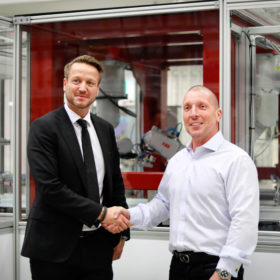
Exeger and ABB to build ‘light harvesting material’ fab in Sweden
Swedish company Exeger says the dye-sensitized ‘light-harvesting material’ it will produce at its facility will generate enough power to prevent the need to recharge portable electronic devices, lengthening battery lifespan perhaps indefinitely.

A whole new KIT of solar cell materials
Scientists at Germany’s Karlsruhe Institute of Technology have received €4.5 million from the Carl Zeiss Foundation to begin a project developing an entirely new solar cell concept they say will combine the printability of organic PV, long-term stability of crystalline solar cells and ferroelectricity of lead-halide perovskites.
Solar will power ahead to offer 20% more output for 25% lower module costs within 15 months
PV industry veteran Karl-Heinz Remmers recalls the trajectory of solar power this decade and predicts stronger than expected development for the ten years ahead.
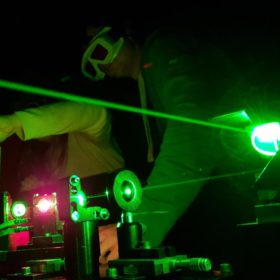
Hot news on harvesting electrons in perovskites
An international research group claims to have developed a new bulk perovskite semiconductor material that can capture the excess energy of hot electrons. The material is said to rapidly absorb as heat energy which would otherwise be wasted. With the harvesting of hot electrons, the maximum theoretical efficiency for hybrid-perovskite solar cells could increase from 33% to 66%.

PV takes a stand at 2019 Web Summit
This year’s record-breaking event held in Lisbon, Portugal, included an energy track devoted to renewable sources and technology to address climate change.
European Utility Week: ‘The confidence is coming back’
The energy transition is becoming ever more apparent among power companies, as was evident at the European Utility Week event last week in Paris, which showcased the hopes and fears of energy companies. Rebranding next year to ‘Enlit’, the organizers aim to reach the whole energy industry.
The weekend read: A responsible compromise?
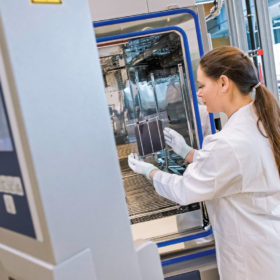
Toxicologists are struggling to follow the pace at which perovskite solar cells race from laboratory test benches to factory production lines. While researchers continue to assess the health and safety risks stemming from the lead used at the core of these new materials, the startups commercializing them argue that established encapsulation techniques and sound recycling schemes are enough to safety-proof their potentially disruptive technology and offset broader environmental threats.
China’s nuclear operator to develop 1 GW solar field
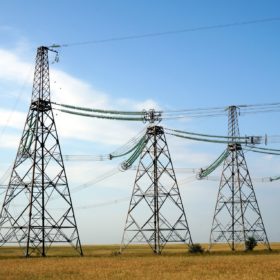
China General Nuclear Power Group is reportedly preparing to invest almost $2.5 billion into a huge solar project – plus 2 GW of wind turbines – in the autonomous province of Inner Mongolia. Local authorities say the massive project will be complete in 2021.
International research group claims 8.8% efficiency for amorphous solar cell
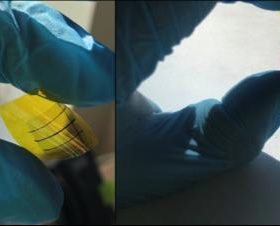
The new cell is based on a p-type transparent conductor made of carbon nanotube fibers. The device is said to offer 16% more efficiency than rival amorphous cells.
A new converter topology for hybrid wind-solar
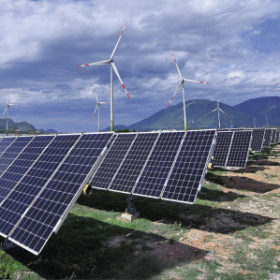
A researcher has proposed a new approach to apply maximum power point tracking techniques to optimize electricity production in wind-solar power projects. The permanent magnetic synchronous generator hybrid model used in the study is based on a multi-input rectifier stage which is said to be able to eradicate current harmonics and eliminate the need for extra input filters.
