
German report makes recommendations for private PPA adoption in China
The German Energy Agency has drawn up a list of proposed measures which it says could help the world’s biggest solar market accelerate its clean energy plans through the adoption of subsidy-free – private – power purchase agreements.
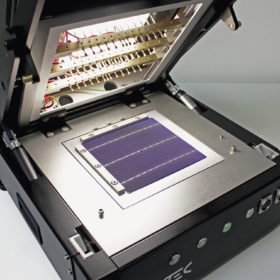
JA Solar granted intellectual property rights for Ga-doping technology
The Chinese company has announced it has acquired intellectual property rights pertaining to various applications of gallium-doped silicon wafers in solar cell applications from Japanese company Shin-Etsu Chemical.
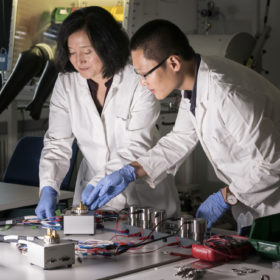
Calcium batteries cool down with new electrolyte
Scientists at Germany’s Karlsruhe Institute of Technology have developed a new class of electrolytes they say could bring calcium batteries – currently only a lab technology – a step closer to being a practical reality for energy storage.
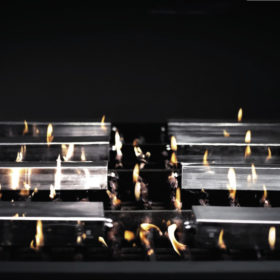
ConFlow wraps up acquisition of AI-powered battery testing technology
The company launched a solid-state battery in August it claimed could recharge itself to some degree from electrons in the air. Now ConFlow is preparing to test its devices with the help of artificial intelligence-powered monitoring devices in the new year.

Tennet invests another €235 million to integrate renewables
Dutch transmission system operator Tennet, which also serves Germany, said the investment will be used to connect around 2 GW of renewables generation capacity to the high-voltage transmission system of the northern Netherlands.
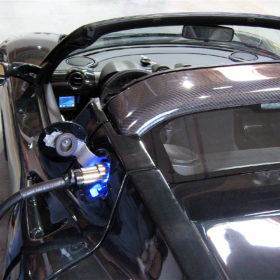
‘They created a rechargeable world’
American John B. Goodenough, Brit Stanley Whittingham and Akira Yoshino, from Japan, will receive the Nobel Prize for Chemistry for developing the lithium-ion battery. A statement from the Royal Academy of Sciences of Sweden said the invention “laid the foundations of a society without wires and fossil fuels, and [they] are of great benefit to humanity”.
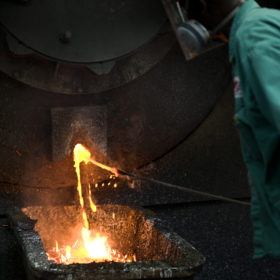
Do lead batteries have a role in the clean energy transition?
The Consortium for Battery Innovation has outlined research goals for advanced lead-based battery concepts, claiming the potential of the technology is “nowhere near fully exploited”. The group, comprised of lead-battery industry stakeholders, says such devices can play an important role alongside lithium-ion and other storage technologies in electric vehicles, renewable energy storage and other applications.

A new generation of nano-architected, 3D solar cells
A group of scientists at Netherlands based research institute AMOLF have discovered a method for electrochemical printing at the nanoscale. With further optimizations, the group theorizes, the technique could allow for the development of new, three dimensional solar cells.

Siemens backs 5 GW green hydrogen plan for Australia
A massive green hydrogen production project has been unveiled in Western Australia with Siemens on board as technology partner. The location has been touted as Australia’s best for solar and wind power generation potential.
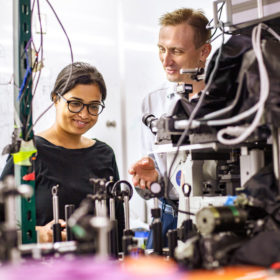
Questioning the quantum behavior of perovskites
Scientists at the University of Texas at Dallas have made a discovery they say has “altered the understanding of the fundamental properties of perovskite crystals”. Their findings could improve understanding of defect formation in perovskites, leading to devices with enhanced performance and stability.
