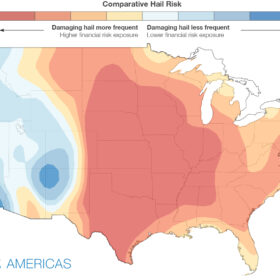
Atlas details economic risks of hail damage to US solar sites
VDE Americas’ new hail risk atlas, now available for use on the Esri ArcGIS platform, can compare and evaluate the site-specific hail risk of current and future solar projects across the United States.

New test method for curved VIPV surfaces
IEA-PVPS has conceived a new test method and analysis of the impact of curvature in vehicle-integrated photovoltaics (VIPV) surfaces. Over the course of an 8-day summertime trial in south-eastern France, the researchers found that the curvature triggered irradiance and temperature non-uniformity of up to 261W/m² and 13 C, respectively.
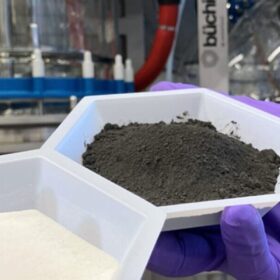
German project for fast industrial implementation of sodium-ion battery technology
Cheap, safe, widely available sodium could be used for battery energy storage alongside photovoltaics. The Sodium-Ion-Battery Germany (SIB:DE) Research project is investigating whether sodium-ion technology can be affordably integrated into lithium-ion battery production facilities.
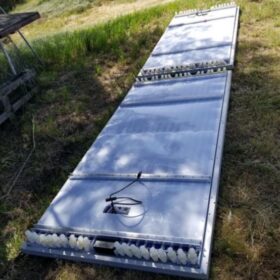
Canadian startup secures patent for solar module cooling tech
Enertopia has developed a solar module cooling system that uses a moisture collection layer to transfer heat while capturing water for irrigation in arid regions. The design channels heat from the panel to a liquid transfer system, improving efficiency and water use.
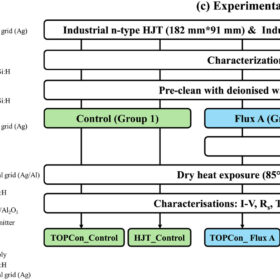
Study shows sensitivity of heterojunction solar cells to soldering flux
An international research team has assessed the impact of soldering flux on heterojunction solar cells and has found that the composition of this component is key to prevent major cracks and significant peeling.
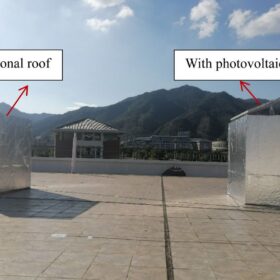
New research suggests optimal tilt angle, overhead height for rooftop PV systems
Researchers in China have investigated the effect of the overhead height and tilt angle on thermal and energy-saving performance of photovoltaic roof and have found that the comprehensive energy-saving efficiency of parallel overhead photovoltaic roofs are optimal in summer and the worst in winter.

Solar thermal developer ticks off final technology milestone
Vast Renewables has successfully completed large-scale testing of a concentrated solar thermal power receiver tower destined to be deployed as part of a 30 MW / 288 MWh solar and energy storage project planned for South Australia.

The Hydrogen Stream: TalusAg starts green ammonia production in Iowa
Landus and TalusAg have launched commercial green ammonia production in Iowa, backed by US federal clean hydrogen tax credits, while Iberdrola España and BP have started building Spain’s largest green hydrogen project, with 25 MW of capacity.

US startup developing defrost-free residential heat pump for cold climates
TerraVis Energy claims its new heat pump system can achieve a seasonal coefficient performance of 3.5 and deliver 30 C of heat indoors at -50 C. CEO Lorenzo Rossi told pv magazine that the system could be produced at a lower cost than conventional models.

Swedish startup offers n-type conductive inks for organic, perovskite solar cells
N-ink, a spinoff of the Linköping University, has developed conductive inks that can be used in the charge extracting layer of organic solar cells and in transport layers of perovskite solar cells.
