
ETH Zurich unveils new tech to produce heat with solar
Swiss researchers have engineered a device that uses solar energy to heat to more than 1,000 C. The technology could make it possible to use solar energy to decarbonize energy-intensive industries that require high temperatures for production processes.

New dates, rules for 2025 Bridgestone World Solar Challenge
The Bridgestone World Solar Challenge has announced a new set of dates for for the 2025 edition of its unique 3,000 km solar car race across the Australian continent, along with some regulation changes.
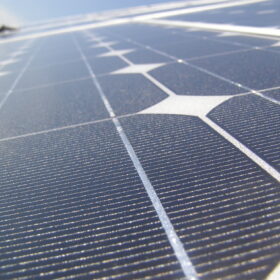
Novel hydrophobic, antireflective coating for solar glass
Slovakian scientists have developed a novel hydrophobic, antireflective coating for solar glass with a silica-titania thin film as the bottom layer and an inorganic-organic upper layer made of silica modified with triethoxy(octyl)silane. This new coating increases glass transmittance by 7% compared to uncoated glass.
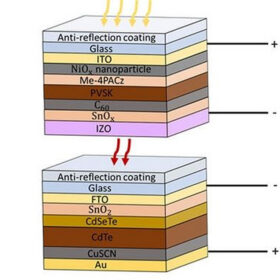
U.S. scientists demonstrate 25%-efficient perovskite-cadmium tandem solar cell
The researchers say the cell has a top perovskite cell with a transparent back contact made of indium zinc oxide and a commercially established cadmium telluride bottom device. They claim the champion tandem cell has the potential to reach a 30% efficiency.
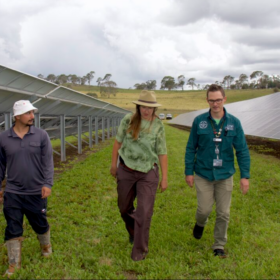
New guide to improve biodiversity of PV projects in Australia
An Australian community group has launched a new guide to help solar developers to improve biodiversity on project sites and build trust in neighboring communities without compromising PV generation capacity.
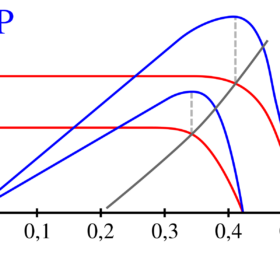
New MPPT technique based on improved snake algorithm
Researchers from China have suggested to use the so-called improved snake optimizer (ISO) algorithm for maximum power point tracking in PV systems. The proposed algorithm can reportedly achieve a higher PV system performance and better accuracy than the simple snake algorithm.

Fraunhofer ISE unveils rotary printing technique for heterojunction solar cell metallization
Researchers at the German research institute have found that indirect gravure printing for metallization of silicon heterojunction solar cells reduces silver consumption and cycle times to below 0.5 seconds per cell, while still enabling conversion efficiencies of up to 20.7%.

US startup debuts wall-mountable residential heat pump
US-based Quilt has unveiled a residential heat pump with a coefficient of performance (COP) of up to 4 and noise levels of 27 dBA to 47 dBA. The startup recently raised $33 million (€30 million) from a group of investors.
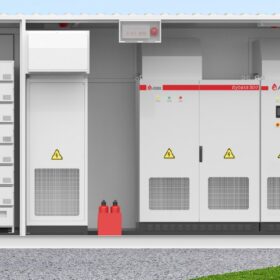
Atess Power releases new series of BESS containers
Atess Power has developed a new series of battery energy storage system (BESS) containers. The Chinese manufacturer is offering 20 HC and 40 HC containers, as well as battery-only containers with storage capacities up to 3,440 kWh.

World’s largest compressed air energy storage project comes online in China
Zhongchu Guoneng Technology Co., Ltd. (ZCGN) has switched on the world’s largest compressed air energy storage project in China. The $207.8 million energy storage power station has a capacity of 300 MW/1,800 MWh and uses an underground salt cave.
