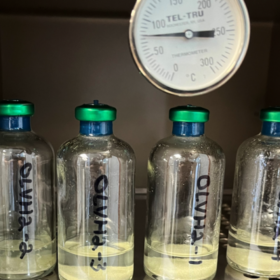
Developing hydrogen fuel from iron-rich rocks
Researchers at UT Austin have secured grant funds from the US Department of Energy to produce hydrogen fuel from rocks in an emissions-free process.
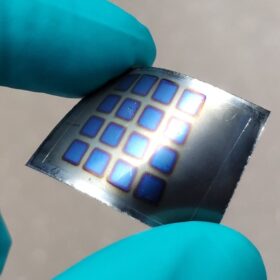
Perovskite-CIGS tandem solar cell based on fexible steel substrate achieves record-breaking efficiency of 18.1%
Scientists in Australia claim to have achieved the highest efficiency ever reported to date for a perovskite-CIGS tandem solar cell built on a flexible steel substrate. In the proposed cell configuration, steel can act as both a substrate and an electrode.
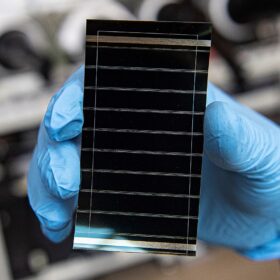
Researchers discover additive that enhances perovskite coating process
By adding an ionic pair stabilizer to perovskite cells enables coating to take place in ambient air, simplifying the manufacturing process.

The Hydrogen Stream: Stadler finalizes longest hydrogen train test
Stadler says it has wrapped up a hydrogen train test, while Ballard has secured a long-term agreement to supply 1,000 hydrogen fuel cell engines through 2027.

Thermoelectric heat-pump boosters can increase supply-water temperature in district heating by 10 C
A Slovenian research group has proposed using a heat pump booster instead of vapor compression technologies in low-temperature district-heating substations and has found that this combination may raise the supply-water temperature from around 32 C to 42 C. In the proposed system configuration ten single-stage Peltier modules were used, each with a maximum cooling power of 165 W and a maximum electric power of 289.2 W.
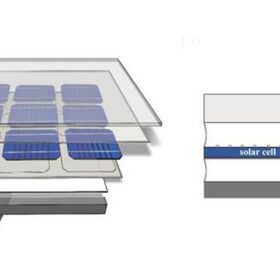
New decapsulation tech for solar module recycling
The Chinese Academy of Science has developed a new technique that uses non-toxic lemonene as a reagent to control the degree of EVA expansion during the decapsulation process of end-of-life photovoltaic modules. The proposed approach reportedly achieves the complete delamination of glass and backsheet without excessive damage to the solar cells

Perovskite solar cell based on ‘multifunctional’ hole transporting material achieves 26.41% efficiency
Researchers in China claim to have achieved the highest efficiency ever reported for perovskite solar cells based on “alternative” hole transport materials. The device reportedly offers improved hole extraction and significantly reduced charge recombination at the interface between the perovskite layer and the hole transport layer.
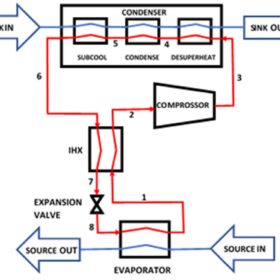
Testing zeotropic fluids in high-temperature heat pumps
A German-Nigerian research group simulated the usage of mixtures of zeotropic fluids with varying boiling or condensing temperatures in industrial heat pumps. The best results were obtained with a mixture of cyclohexane and cyclopropane.

Growatt launches new balcony storage solution
The new product combines the NEO 800TL-X Microinverter and the NOAH 2000 Battery. Up to four batteries can be stacked, for up to 8,192 Wh of storage capacity.

Germany has urgent need to expand solar module recycling capacities, IEA-PVPS says
Feedback from stakeholders involved in Germany’s end-of-life PV modules treatment chain found more needs to be done around the transparency of PV module waste volume, the take-back and collection process and module recycling, as the country prepares for significantly larger volumes by the end of the decade.
