
US startup debuts wall-mountable residential heat pump
US-based Quilt has unveiled a residential heat pump with a coefficient of performance (COP) of up to 4 and noise levels of 27 dBA to 47 dBA. The startup recently raised $33 million (€30 million) from a group of investors.
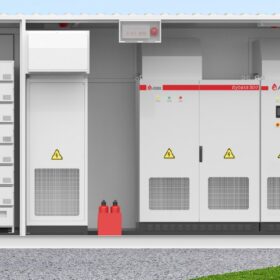
Atess Power releases new series of BESS containers
Atess Power has developed a new series of battery energy storage system (BESS) containers. The Chinese manufacturer is offering 20 HC and 40 HC containers, as well as battery-only containers with storage capacities up to 3,440 kWh.
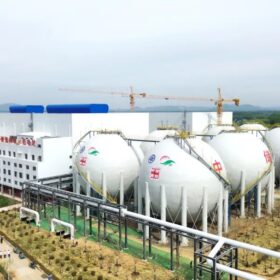
World’s largest compressed air energy storage project comes online in China
Zhongchu Guoneng Technology Co., Ltd. (ZCGN) has switched on the world’s largest compressed air energy storage project in China. The $207.8 million energy storage power station has a capacity of 300 MW/1,800 MWh and uses an underground salt cave.

Cadmium-doped perovskite solar cell achieves 22.7% efficiency
A Chinese-Canadian research group has utilized for the first time a cadmium iodide doping technique to stabilize the blade coating process in the manufacturing of solar cells based on formamidinium lead iodide (FAPbI3) perovskite. The academics built a cell showing a considerable increase in efficiency compared to an identical device without cadmium doping.

3D printed clamps for front-surface PV mounting on wood racking
A research team proposed a new PV mounting solution relying on two types of spacers and two types of clamps that can be printed with common printing materials. The cost of the different solutions presented varies from CAD1.50 ($1.10) to CAD3.83.
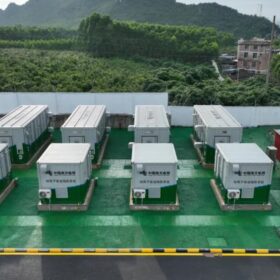
China switches on first large-scale sodium-ion battery
China Southern Power Grid has deployed a 10 MWh sodium-ion battery in China’s Guangxi Zhuang region. It is the first phase of a 100 MWh project.
Faulty installations often to blame for battery fires
The Electric Power Research Institute (EPRI), the US Department of Energy’s Pacific Northwest National Laboratory (PNNL), and German battery analysis specialist Twaice have jointly evaluated 26 battery fires between 2018 and 2023. They say that the diversity of components plays a critical role in igniting fires.

Enhancing photovoltaic-thermal module performance with Tesla valves
Scientists in China have demonstrated a photovoltaic-thermal system that utilizes Tesla valves to increase cooling and efficiency. The system was found to have better performance compared to PVT systems made with several different cross-sectional structures.
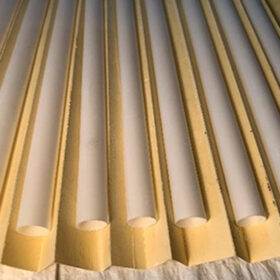
Australian startup, EDF team up to test electrolzyer tech
A startup spun out of the Australian Commonwealth Scientific and Industrial Research Organisation (CSIRO) has secured a grant to build a 5 kW electrolyzer that will be deployed at a UK power plant operated by French energy utility EDF.
Improving LCOE of PV-driven hydrogen via reciprocating engines
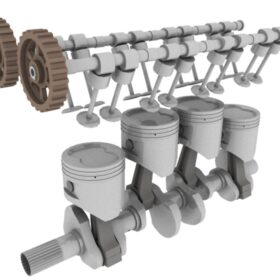
UNSW scientists have suggested to use dual-fuel reciprocating engines for adding gas-to-power operations in large scale production of hydrogen based on PV power. The preliminary findings of their research show that the proposed system is still achieving a too high LCOE for commercial maturity. Decreasing electrolyzer costs, policy interventions and changing energy market dynamics, however, may more than halve the LCOE values in the future.
