
K2 Systems launches mounting systems for facades
Germany’s K2 Systems has developed mounting systems that are specifically designed for facades, including walls made from masonry, concrete, sandwiched panels, trapezoidal metal sheets, and corrugated sheets.

New electrolyte for safer, more stable solid-state batteries
Researchers in Japan have discovered a stable, highly conductive material that can be used as electrolyte for solid-state lithium-ion batteries. The material’s ionic conductivity is said to be higher than any previously reported oxide solid electrolytes, with a wide operating temperature range.

Producing hydrogen via microalgae-bacteria coculture
A group of researchers has identified a multispecies bacterial community that could reportedly increase the efficiency of hydrogen generation via microbial metabolism. The proposed hydrogen system achieved a more than double production rate compared to common biological hydrogen production technologies.
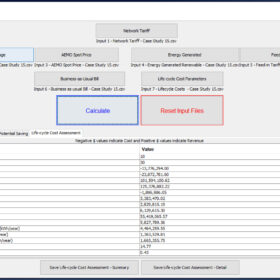
Open-source software helps stakeholders make cost-effective renewable energy investments
Conceived by a group of scientists in Australia, the novel online tool can be modified for different regulatory environments. The program’s user interface asks for seven input files with a resolution of 30 minutes.
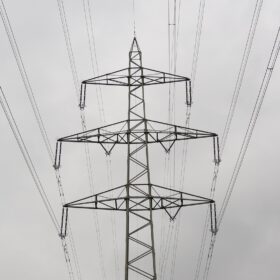
Belgian grid operator pays for residential PV curtailment
Fluvius, Belgium’s electricity grid operator, says it will compensate residential PV systems at €10.60 ($11.49) per kVa if they are not reconnected within 30 working days after a curtailment event.
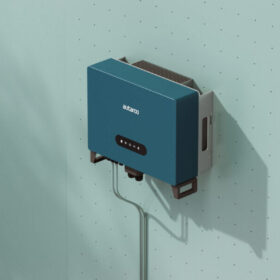
Autarco releases three-phase hybrid inverters
Autarco has developed a three-phase hybrid inverter line, featuring 8 kW, 9.6 kW, 12.8 kW, and 16 kW versions and up to four independent maximum power point (MPP) trackers, along with a European efficiency rating of 97.5%.
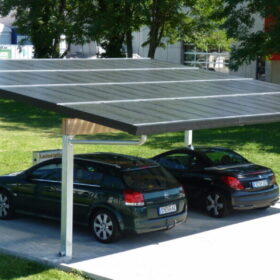
German mounting system supplier offers online tool for solar carports
Clickcon has launched an online tool to design solar carports and shades. The tool uses the German company’s mounting systems for the designed projects.
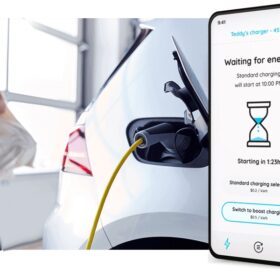
SolarEdge acquires EV charging optimization and management startup
Wevo Energy becomes a subsidiary of SolarEdge, and together the companies plan to integrate the Wevo’s software solution into the SolarEdge ONE energy optimization system for the commercial and industrial (C&I) segment.
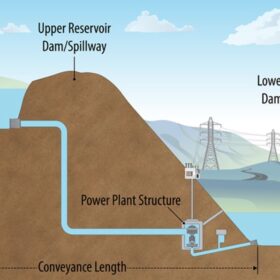
NREL releases online tool to estimate pumped hydro storage costs
The US Department of Energy’s National Renewable Energy Laboratory (NREL) has released a cost-estimation tool for new closed-loop pumped storage hydropower (PSH) plants in the United States. The tool allows operators to select from a range of system characteristics and account for factors such as local geology, labor rates and inflation.

Vehicle-integrated photovoltaics making the moves from niche to mainstream
A new report from the International Energy Agency’s Photovoltaic Power Systems Programme (IEA-PVPS) looks at success factors required to take vehicle integrated photovoltaics (VIPV) from niche to mainstream based on a survey of 110 experts in the topic of transport and PV.
