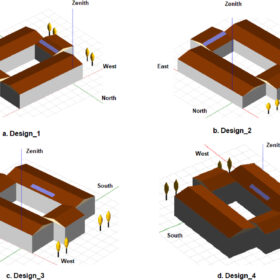
Improving performance ratio of PV systems via shading effect
Researchers in Indonesia have investigated how shading effects may influence the performance ratio of a PV system. Their analysis also considered payback period and return on investment.

Chinese PV Industry Brief: JinkoSolar breaks ground on 56 GW solar factory
JinkoSolar has broken ground on a 56 GW PV panel factory in China’s Shanxi province. It says the new facility will be vertically integrated and will be constructed in four 14 GW phases.
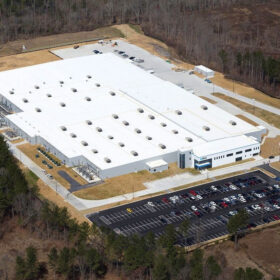
US solar industry calls for domestic content rules to support manufacturing
A recent report from the Solar Energy Manufacturers for America Coalition (SEMA) shows that with stronger support in the early stages, US module manufacturers would rely less on imports from Chinese-owned companies for materials.
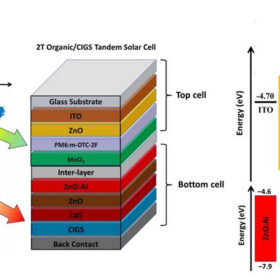
New design for organic/CIGS tandem solar cells promises 27.46% efficiency
Scientists in the Middle East designed a flexible two-terminal organic/CIGS tandem solar cell for wearable applications. The device achieved an open-circuit voltage of 1.89 V, a short-circuit current density of 17.55 mA/cm2, and a fill factor of 82.79%.
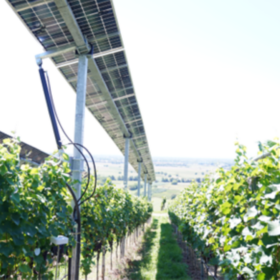
Tracker sensors for agrivoltaics
Sensors from German electronics manufacturer SICK are used in solar PV tracking systems since 2021. Now they are making their way into agrivoltaic applications.
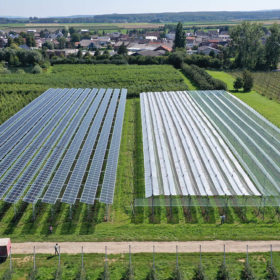
Vast majority of German farmers ready to embrace agrivoltaics
A new survey conducted by Germany’s Fraunhofer ISE showed that 72.4% of the country’s farmers are considering the deployment of an agrivoltaic project. Among the main factors behind this choice, the researchers identified the additional source of income coming from solar power generation and the perceived usefulness of the technology.
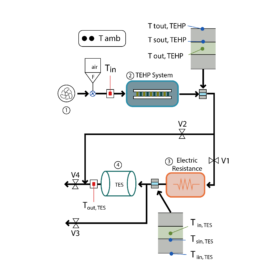
Spanish scientists develop thermoelectric heat pump for thermal energy storage
A Spanish research group has investigated how thermoelectric heat pumps may be used as power-to-heat technology to increase temperatures in thermal energy storage systems. It found the proposed system configuration may achieve an overall efficiency of 112.6% at at 135 C.
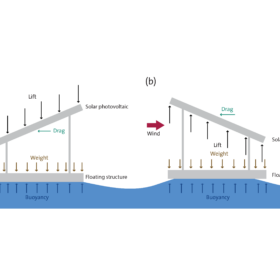
Assessing wind sensitivity of offshore floating solar
Researchers in China have conducted a numerical study on the wind sensitivity of offshore floating solar plants. They have tested six row-arrangements of panels and have found an optimal system configuration that is reportedly less sensitive to wind direction.
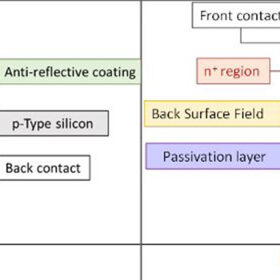
Environmental sustainability in PV technology advancements – life cycle assessment of PERC modules
As photovoltaic (PV) technologies evolve, understanding their environmental implications is crucial for a sustainable energy transition. IEA PVPS Task 12 analyzes the environmental impact of passivated emitter and rear cell (PERC) technology in PV installations in comparison to the monocrystalline silicon technology (AI-BSF) and the trend towards installing horizontal singla-axis tracker systems as opposed to fixed tilt systems. Primary data from one PERC and tracker manufacturer enable this study’s conclusions. Using the life cycle assessment (LCA) methodology, the study compares two locations in Italy with different irradiation patterns to evaluate the sensitivity to solar irradiation. The findings reveal that PERC technology and horizontal single-axis tracker systems demonstrate lower environmental impacts compared to Al-BSF and fixed tilt configurations.
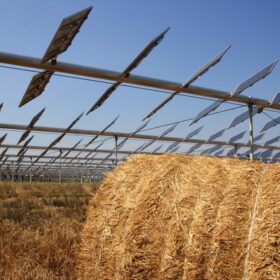
Wheat grows better in agrivoltaic facilities
New research from Italy shows lower wheat production under elevated agrivoltaic systems, but a simultaneous increase in nutritional value for livestock. pv magazine Italy spoke with the academics about their future research.
