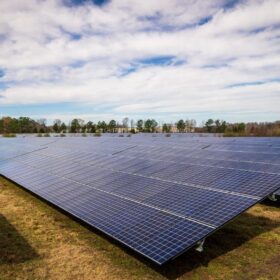
What happens when the sun doesn’t shine?
Pacific Northwest National Laboratory (PNNL) has looked at the frequency and duration of “energy droughts” across the United States, as solar and wind are intermittent energy sources.
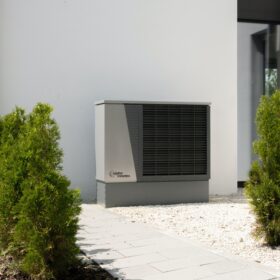
Cambridge scientists recommend careful cost assessment before switching to heat pumps
The researchers said that an increment in heating demand due to the use of heat pumps can be accurately predicted based on heating hours, local climate, heat loss and thermal mass. They also recommended including heat loss and thermal mass parameters in buildings’ energy performance certificates, so households can make more informed decisions before changing their system.
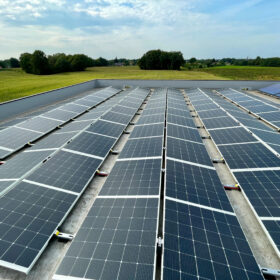
Lightweight PV system solution for commercial buildings with limited load-bearing capacity
Dutch solar PV manufacturer Solarge is deploying a novel lightweight rooftop solution across several commercial buildings in the Netherlands. Instead of glass, the special modules developed by the company use strong and light polymers, which the company said result in a module weight per square meter of 5.5 kg.
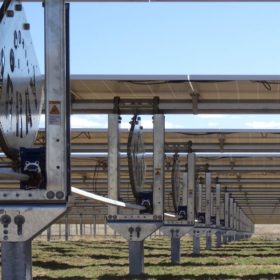
Novel mathematical model to assess wind stability of solar trackers
Researchers from Spain have developed a method to estimate the critical speed a tracker can withstand. They found “good agreement” when comparing the model to experimental results.

The Hydrogen Stream: GM, Autocar aim for hydrogen vehicle production by 2026
GM and Autocar Industries have agreed to jointly develop hydrogen-powered heavy-duty vehicles using GM’s Hydrotec power cubes, while European lawmakers have reached a provisional agreement on common market rules for renewable gases and hydrogen.
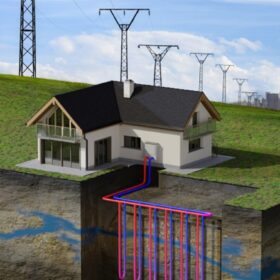
Geothermal heat pumps to decarbonize buildings
The mass adoption of geothermal heat pumps could decarbonize buildings and reduce grid transmission needs, according to a report by Oak Ridge National Laboratory and the US National Renewable Energy Laboratory (NREL).

Gates-backed Fourth Power pilots thermal storage based on TPV cells
Fourth Power, backed by Bill Gates’ venture firm, has developed high-density thermal energy storage (TES) based on thermophotovoltaic (TPV) cells. The tech, which is reportedly 10 times cheaper than lithium-ion batteries, is based on the US company’s patented liquid metal heat transfer system.
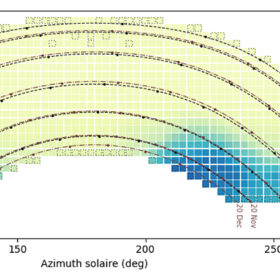
French startup offers AI algorithm package for rooftop PV monitoring
France-based Heliocity has developed HelioFlash, a series of artificial intelligence algorithms that assess PV systems on buildings, while offering recommendations to improve operations.
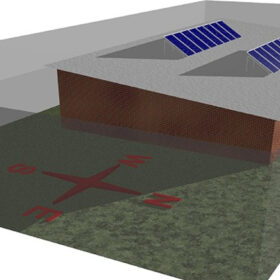
Bifacial PV on rooftops can provide energy yield gains of up to 22.6%
Scientists in Australia have combined Monte Carlo Ray Trace (MCRT) techniques and electrical modeling to assess the potential energy gains of bifacial rooftop PV systems compared to monofacial arrays. They found that rooftop reflectivity is a key factor in increasing a bifacial PV system performance, and that system and module design should also be carefully considered.
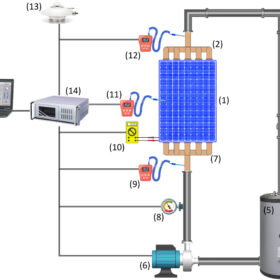
Using waste heat from PV panels to generate residential hot water
Scientists in the United States has developed a new photovoltaic-thermal system design that utilizes parallel water pipes as a cooling system to reduce the operating temperature of photovoltaic panels. The waste heat generated by this process is then used to generate domestic hot water.
