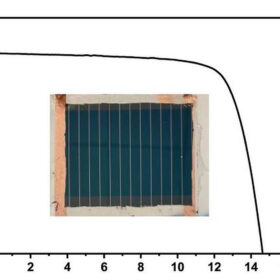
Large-area perovskite-silicon tandem PV cell hits record efficiency of 25.1%
US scientists have achieved a breakthrough in PV cell tech by creating a 24 cm2 perovskite-silicon tandem solar cell. It positions a lithium fluoride interlayer between a hole transport layer and the perovskite absorber to reduce shunting losses.
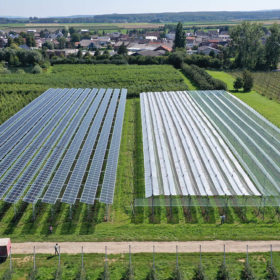
Using agrivoltaics on 1% of EU farmland could lead to 944 GW installed capacity, JRC says
If 157,621 hectares of utilized agricultural area in the European Union incorporated agrivoltaics, it could produce up to 944 GW installed capacity, a new study published by the Joint Research Centre found. Despite the optimism, certain challenges – such as no clear definition and dedicated standards – stand in the way of the technology’s success.
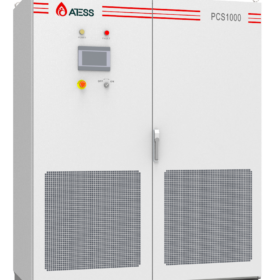
Atess releases new 1 MW battery inverter
Chinese manufacturer Atess has developed PCS1000, a 1 MW bidirectional battery inverter for commercial and industrial applications, with a 99% efficiency rating.

German home destroyed by 30 kWh battery explosion
The German authorities have attributed the recent explosion of a 30 kWh storage battery in a private home to a likely technical defect. The incident has left the home uninhabitable, and property damages will likely be substantial, according to investigators.
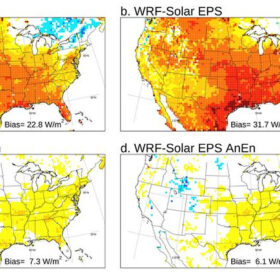
New research points to WRF-Solar forecast shortcomings
A research team in China assessed the accuracy of the WRF-Solar numerical weather prediction model in simulating global and diffuse radiation. The group’s work highlighted the model’s sensitivity to aerosol optical depth, cloud optical thickness, and solar zenith angle.
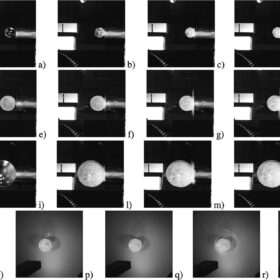
New hail test to assess impact of large, high-velocity ice balls on solar panels
A research group in Switzerland has enhanced the hail test stand to measure the impact of ice balls with larger diameters and higher speed on solar panels. The new testing approach will reportedly enable solar panel makers to assess their products with adequate safety margins.

Qcells fully acquires intellectual property rights for LECO tech
Qcells has acquired full ownership of intellectual property rights for LECO technology with the recent acquisition of Cell Engineering. The technology is known to enhance the efficiency of PERC and TOPCon solar cells.
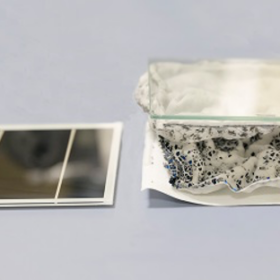
France’s CEA developing tech to recover silicon, silver from end-of-life PV panels
The French Alternative Energies and Atomic Energy Commission (CEA) has developed a recycling process for end-of-life PV modules, recovering silicon and silver, using supercritical CO2. Virginie Basini, head of CEA’s sustainable technologies department, discussed the technique with pv magazine France.
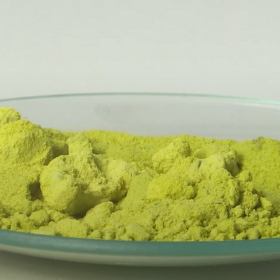
Bismuth ferrite, tungsten trioxide thin films for PV cells
Researchers recently identified the optimal laser energy for crafting BFO/WO3 bilayer thin films for solar cells at 200 millijoules (mJ), by carefully considering factors such as leakage and band gap.
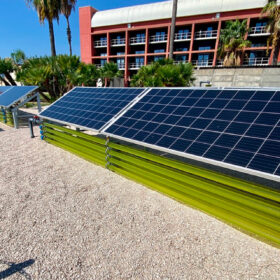
ENEA, Enel unveil ‘algovoltaic’ system
ENEA and Enel have developed an ‘algovoltaic’ system to cultivate high-value microalgae, ranging from €100 ($106.19)/kg to €600/kg for pharmaceutical uses or cosmetic purposes. This is possible due to the integration of a fully automated cultivation system with a 7 kW solar array.
