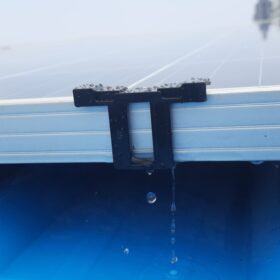
Prasham Greens unveils water-draining clamps for solar panels
India’s Prasham Greens has designed water-draining clamps to get rid of accumulated water from the edges of solar panels after rain and water-based cleaning.
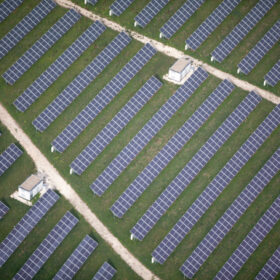
New research claims 85 solar plants in Czechia reached end of lifetime after only 12 years
Data monitoring from 85 PV power plants built in Czechia between 2009 and 2010 show delamination plays a crucial role in significantly reducing their expected lifetime. The scientists behind the research explained that the main cause for the reduced lifetime was due not only to a poor estimation of the technical possibilities of the PV panels at the time of planning and installation, but also to a profit-led approach aimed at lowering the costs of the projects.
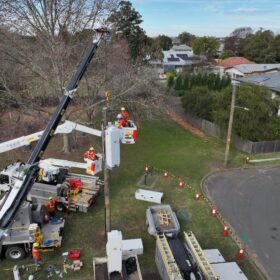
Australian grid operator adopts pole-mounted storage tech
Ausgrid has installed its first pole-mounted battery energy storage system as part of a trial to more effectively manage growing penetration of rooftop solar and periods of peak demand.
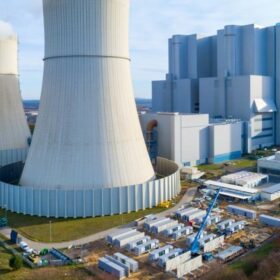
LEAG plans 950 MW power-to-gas plant at lignite mine
LEAG, Germany’s second largest energy supplier, is planning a power-to-X project to produce hydrogen, store waste heat, generate electricity, and supply buses with hydrogen. The plant will also have a thermal solid-state storage facility with a capacity of 1,000 MWh.

Indian startup releases new hybrid wind-solar street light system
India’s WindStream Energy Technologies has developed a hybrid wind-solar street light system for hilly, coastal, and rural areas.

Conquering change: Artificial Intelligence and how to be future ready
The rise of Artificial Intelligence (AI) technologies presents a big opportunity for the energy industry. AI and the language of the input query provide us with a powerful tool against incorrect information.

Commercial laser treatment to boost perovskite solar cell performance
European scientists used a nanosecond pulsed ultraviolet laser to reduce surface defects in perovskite films for solar cell applications. The result is a significant increase in cell efficiency and stability. The new technique may be particularly suitable for roll-to-roll (R2R) production lines.
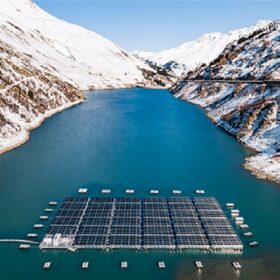
Comprehensive review of all water-related PV technologies stresses need for careful planning
A new study of existing research on water-based PV (WPV) technologies points to gaps in published reports on the technologies, particularly regarding environmental impacts, in general, and cost analyses for canal top solar, specifically.
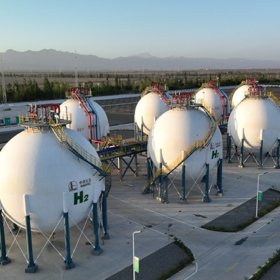
The Hydrogen Stream: China starts world’s biggest solar-to-hydrogen site
China’s Sinopec has switched on the world’s largest solar-to-hydrogen project in Xinjiang, while India has unveiled a new plan to incentivize green hydrogen and electrolyzer production.
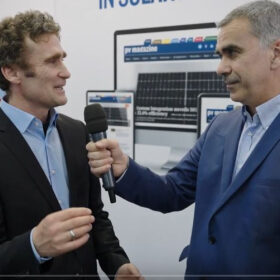
Intersolar 2023: ‘We are working intensively on tandem development’
Jörg Müller, head of R&D for Qcells, recently spoke to pv magazine at Intersolar 2023 about the South Korea-based solar manufacturer’s tech roadmap, the adoption of TOPCon, and the prospects for making tandem perovskite-silicon modules. He said the first tandem products could hit the market by 2030.
