Renewables overbuilding, proactive curtailment can reduce Europe’s energy system costs
New research from the Netherlands showed that renewables and short-term storage can meet around 92.5% of Europe’s electricity demand in future energy scenarios, with the remaining 7.5% being satisfied by green hydrogen. The scientists considered Europe as fully self-sufficient with zero import-export of power or hydrogen, with each of the 37 countries included in the modeling having a self-sufficiency rate of at least 80%.
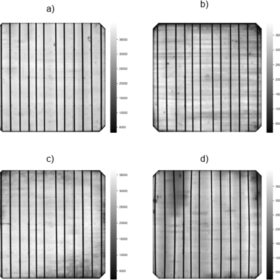
Copper-metalized heterojunction solar cells close to achieve same efficiency as silver-based counterparts
Researchers in Germany have shown that heterojunction solar cells screen printed with silver-copper on the front side and silver paste on the rear side can achieve a 0.13% efficiency gain over reference screen-printed bifacial cells based on silver alone. The research group worked specifically on dispensing and screen printing as printing methods.

Cobalt-iron catalyst boosts zinc-air battery stability and performance
Engineers at Monash University in Australia have developed a new catalyst they say could bring zinc-air batteries “closer to real-world, grid-scale and transport uses.”

Swiss startup offers timber-framed solar carport
Urbanpv has developed a timber-framed 46 kW parking lot design for ten parking spaces including the access lane.

Enhancing dual-axis solar tracker performance with new optimization techniques
Researchers in India have developed two solar tracker optimization techniques can purportedly increase power generation by up to 54.36% when combined. One uses a light sensor and the other relies on data from GPS and a real-time clock.
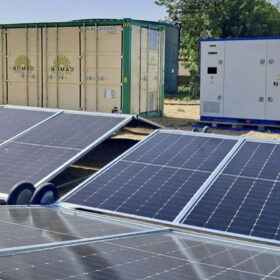
Spanish startup offers portable solar-plus-storage generators for irrigation
Spanish startup Nomad Solar Energy and Full&fast have deployed a portable solar-plus-storage system at a Madrid farm to provide off-grid power for irrigation.

Enpal unveils residential heat pump for large heating loads
The German company is introducing its own heat pump with a heating output of up to 16 kW and a maximum flow temperature of 80 C. The system is designed to meet rising demand in large single-family homes and unrenovated existing buildings.
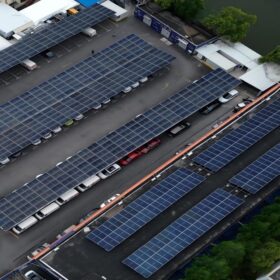
Optimization strategy for PV-powered EV charging stations relying on V2G
Scientists in China have created an optimization technique for an electric vehicle charging station that uses PV, battery storage, and a vehicle-to-grid operation. Considering the uncertainty of PV generation and the randomness of EV load, the system uses two-level optimization, day-ahead and intra-day.

Korean scientists achieve 21% efficiency in polycrystalline solar cell for underwater environments
The cell was fabricated with a 2.3 nm-thin layer of gallium oxide, a silver busbar aimed at improving charge collection and silicon nitride anti-reflection coating. It was encapsulated within a watertight 3D-printed box to ensure impermeability.

Optimum tilt angle for PV systems ranging from 0° to 90°
A Slovak research team has developed a mathematical model for determining the optimum tilt angle of a solar system ranging from 0° to 90°. Their framework was tested on an experimental setup in Czechia and attained 93.9% accuracy in predicting the system’s energy balance.
