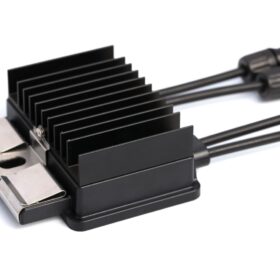
US manufacturer releases new dual solar optimizer
Enteligent, a residential PV solutions specialist, has introduced an optimizer model that can be paired with two solar panels. It claims that it features rapid shutdown and monitoring capabilities.

Copper thiocyanate to eliminate moisture leaks in perovskite PV cells
Indian scientists have replaced Spiro-OMeTAD with copper thiocyanate (CuSCN) as a hole-transporting material in a perovskite solar cell. They say that the new precursor can offer the same efficiency levels, while reducing moisture leakage.

Australian manufacturer reveals 1 MWh sodium chloride battery design
Altech Batteries, a battery tech company in Western Australia, has included “game-changing” sodium chloride technology in its new battery 1 MWh GridPack. It said it expects the new systems to be up to 40% cheaper to produce than dominant lithium-ion alternatives.
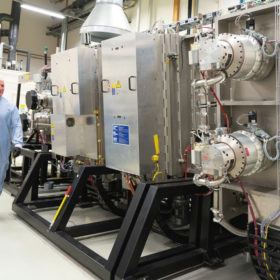
Weekend Read: Industry and researchers in tandem
As efficiency records tumble and devices become more stable, Europe is seeing the beginnings of a race to commercialize high-efficiency perovskite-silicon tandem solar products, reports Valerie Thompson.

The Hydrogen Stream: Sunfire delivers 10 MW of alkaline electrolyzers to RWE
RWE has revealed that it has received alkaline electrolyzers from Sunfire for a pilot project in Germany, while the European authorities have reached a deal on the continent’s renewable energy directive.

Belgian developer starts digging hole for geothermal heat pumps in Bruges
Property developer Steenoven and an undisclosed construction contractor have started drilling a borehole for a new thermal energy storage system in the historic city of Bruges, Belgium.
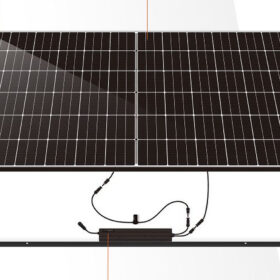
DAH Solar unveils solar kit for balconies, rooftops
China’s DAH Solar has developed a turnkey solar system with a plug-in connection for residential applications. The kit can reach a maximum size of 2,279 mm × 1,134 mm × 32mm and weighs up to 59.8 kg.
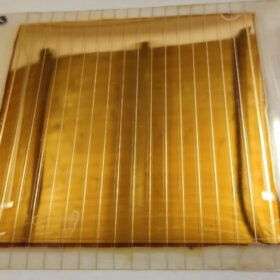
Blade-coated flexible perovskite solar cell achieves 14.08% efficiency
Researchers in Italy have used blade coating to develop a flexible solar cell that does not contain toxic dimethyl sulfoxide. They used the cell to fabricate small solar modules with efficiencies of up to 6.58%.
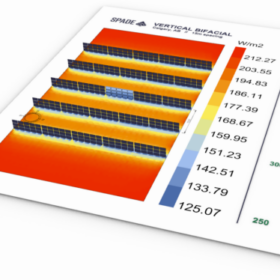
New software modeling tool for agrivoltaics
Sandbox Solar, a solar developer and US federal grant recipient, has released a beta version of its software modeling tool for agrivoltaic power plants. It supports the design and optimization of solar panels, as well as the crops underneath.
Case study demonstrates 5% energy yield boost for n-type TOPCon modules
Data collected from a 30 MW PV project in China’s Tianjin Province demonstrates that n-type tunnel oxide passivated contact (TOPCon) modules achieve a little more than 5% more energy yield than p-type PERC. Analysis by JinkoSolar, which supplied its TOPCon modules to the project, credits the n-type modules’ increased performance to a better temperature coefficient in the project’s hot climate, higher bifaciality and lower degradation.
