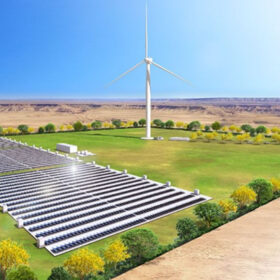
Toshiba ESS tests hybrid wind-solar project with storage in Saudi Arabia
Toshiba Energy Systems & Solutions Corp. (Toshiba ESS) has started testing batteries and energy management solutions to stabilize electricity in remote Saudi Arabia through a hybrid wind-solar pilot project. The project will run until May 2028 to evaluate power- and energy-oriented batteries and optimize battery use.
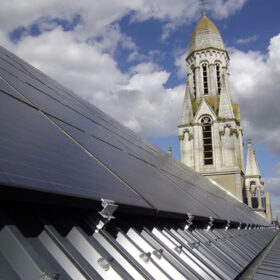
France’s Solarpro launches steel deck mounting system for rooftop PV
Solarpro has developed a steel deck mounting structure with a drilling-free fixing system for rooftop solar panels.
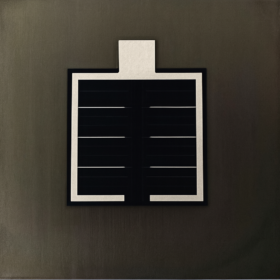
Perovskite-silicon tandem solar cell with steric complementary design achieves 32.3% efficiency
Researchers in China developed a monolithic perovskite-silicon tandem solar cell using a steric-complementary interface design, achieving a certified efficiency of 32.12% and enhanced long-term stability. This strategy optimizes molecular fit in the perovskite lattice, improving both charge transport and device longevity.
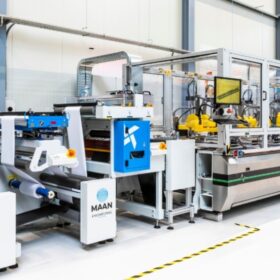
TNO offers mass customization line for integrated PV applications
The Dutch research institute’s highly automated research line offers customized, flexible solar semi-finished PV products to partners developing integrated PV applications.
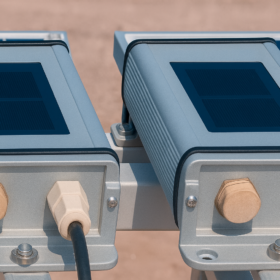
How the world’s sunniest region tackles solar module soiling, cleaning
Researchers studying PV panels in Chile’s hyper-arid Atacama Desert found that cemented soiling can cause annual energy losses of up to 9.8%. Their combined field and laboratory work shows that dry cleaning leaves residue that accelerates future cementation, making wet cleaning the more effective long-term strategy despite higher costs and scarce water.
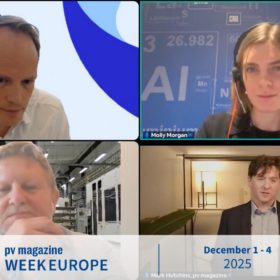
‘Back contact will reach cost parity with TOPCon before end of decade’
During a pv magazine Week Europe 2025 webinar, panelists forecast back contact (BC) solar cells’ market share will draw level with TOPCon towards the end of the decade, before tandem technology begins large-scale momentum in the early 2030s.

IEA sets distributed solar, storage policy path for Ukraine
A report by the International Energy Agency (IEA) recommends three strategies to accelerate the deployment of distributed solar and battery energy storage systems (BESS) in Ukraine as the country works to increase its energy security.
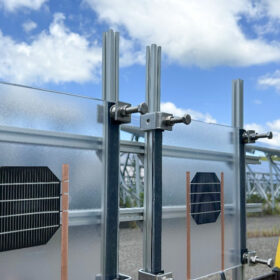
Perovskite solar testing field commissioned in Japan
Kanazawa University has begun long-term outdoor testing of tandem perovskite solar cells in collaboration with Toshiba. The research project aligns with Japan’s broader push to scale perovskite PV technologies toward large deployment by 2040.

Agrivoltaics for biomethane
Researchers in Italy have simulated an agrivoltaic-powered anaerobic digestion plant for biomethane production and optimized it across eight scenarios, using vertically mounted panels in some cases with one-axis tracker and with two-axis trackers in others.
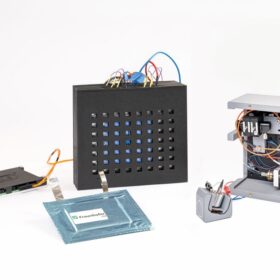
World’s first high-power aluminum-ion battery system for energy storage
For the first time, a complete aluminum-graphite-dual-ion battery system has been built and tested, showing that lithium-free, high-power batteries can deliver stability, fast response, and recyclability for next-generation grid applications.
