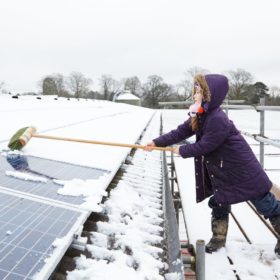
The role of seasonal demand in an all-electric scenario
Peak solar production does not coincide with peak heating demand, and a team of researchers determined that meeting this demand with renewables alone will require massive deployment of renewables on top of existing fossil generation.

US solar sector prepares to meet smart inverter requirements
As several US states will soon require smart inverters for new distributed resources, and more are considering such a requirement, nearly all manufacturers will be delivering smart inverters that meet a new industry standard by August 2023, finds an analysis by the Interstate Renewable Energy Council.

Toshiba energizes PV-powered hydrogen refueling station in Japan
The system is reportedly able to refill about eight hydrogen fuel cell vehicles, each in three minutes. It is also able to supply electric power by using hydrogen produced with renewable energy within the station.

Storing renewables in soil mounds via water balloons
Scientists in Denmark have developed a storage technology that utilizes large underground water balloons and the pressure of the soil to activate a turbine to generate power. They are currently building a first 10 m x 10 m demonstrator to select critical technologies related to the membrane and to the construction of the “movable hill” that will form the terrain part of the battery.
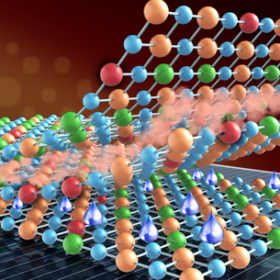
Surface engineering for an 18.6% efficient large-area inverted perovskite solar cell
Scientists in China worked with nickel-oxide as a charge transport layer in a perovskite solar cell, and were able to overcome several of the performance challenges associated with this material through careful surface engineering. Using this approach, the group fabricated an inverted perovskite solar cell measuring 156×156 mm that achieved 18.6% efficiency, along with ‘remarkable’ stability, according to its designers.
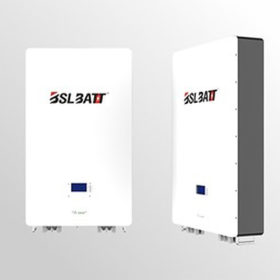
New residential lithium-ion battery from China
Chinese manufacturer Bslbatt has unveiled an upgraded version of its residential battery. The device has a storage capacity ranging from 5.12 to 12.8 kWh and is reportedly able to provide steady operation for up to 6,000 charge cycles.
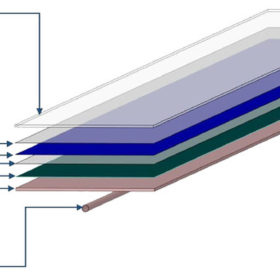
Photovoltaic thermal panel with overall efficiency of 83% via MXenes nanofluid
UK researchers have demonstrated a photovoltaic thermal panel that utilizes an MXene/water nanofluid for heat transfer. They said the nanofluid is not only able to improve the thermal and electrical performance of the panel, but also to reduce its size by 14.5%.

Chinese PV Industry Brief: Polysilicon price remains flat
In other news, JinkoSolar is seeking to raise CNY 10 billion ($1.48 billion) to finance its capacity expansion plans and Trina Solar predicts strong profit growth for the first half of the year.

Forecast methodology for photovoltaic power yield during solar eclipses
In October there will be a partial solar eclipse in Central Europe. The Fraunhofer IEE has developed a solution that reportedly enables the most accurate forecast possible of the photovoltaic feed-in power during the extreme event.
Reverse bias – a hidden challenge for perovskite solar cell stability
New research from renowned PV scientist Martin Green and colleagues at UNSW reveals that perovskite solar cells may struggle to deal with reverse-bias caused by uneven shading or other issues likely to appear in the field. Both the reverse-bias itself and resulting build up of heat can cause several of the materials commonly used in perovskite solar cells to degrade, and these issues have received only limited attention in research published to date. Solutions, however, are at hand.
