
How artificial intelligence can be used to identify solar panel defects
Solar farm operators are turning to AI-powered inspection to speed up the inspection process and improve accuracy. They use algorithms that can automatically detect solar panel defects from images.
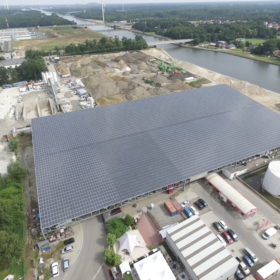
Economic and technical feasibility of a storage-as-a-service model using second-life batteries for a commercial end-user
As part of the EU Horizon 2020 CIRCUSOL project, Belgian PV installer and investor Futech investigated the technical and economic feasibility of integrating a second-life battery storage system at an existing 2MW solar plant in Belgium. The system originates from the automotive industry and was successfully commissioned in August 2021.

Australian startup gets funds to commercialize modular hydrogen-powered energy solution
Australian startup Endua’s plan to make modular hydrogen-powered energy generation and storage systems has been given a financial boost, as the federal government has provided it with almost AUD 1 million ($719,800) to help it commercialize its technologies.
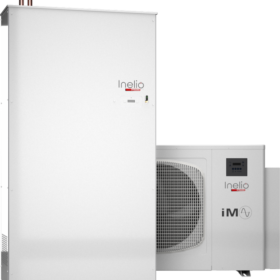
Residential heat storage system uses PV electricity for space heating, hot water
France-based FHE Group has developed a 2.5 kWh storage device that can store electricity as heat during the day and release this heat at night to power a heat pump for space heating and hot water. According to the manufacturer, it can retain over 95% of its initial performance after 20,000 cycles.
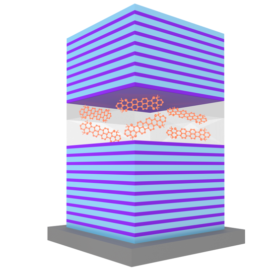
Quantum battery prototype for superextensive charging
Scientists in Italy designed the prototype as a microcavity enclosing a molecular dye known as Lumogen-F orange (LFO). The charging power of the device is described as super-extensive, meaning that it increases faster with battery size.
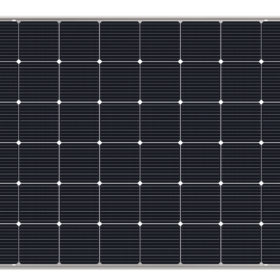
TOPCon vs PERC
TOPCon solar cells are on their way to fully compete with PERC solar products, according to recent research from Germany’s Fraunhofer ISE. Efficiency gains for the TOPCon concept, however, are necessary to help it capture more market share, as production costs remain higher than those for PERC tech. A series of cost-driven strategies to make TOPCon modules advance were outlined in the study.

Photovoltaic skylight for the Port of Malaga
The solar skylight has a peak power of 20kW. It is made up of 70 crystalline silicon photovoltaic glass modules of different sizes and shapes.
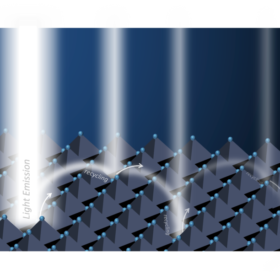
Photon recycling for more efficient perovskite solar cells
Scientists at the Technische Universität Dresden, in Germany, have found that photon recycling and light scattering effects greatly improve light emission in perovskite solar cells, thereby boosting the upper limit for their efficiency to 31.3%.

Vertical agrivoltaic project takes shape in France
The 100kW pilot vertical PV plant is being developed by French energy giant Engie. It will be used to test the effects of agrivoltaics on the microclimate, soil and vegetation.
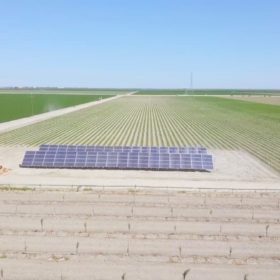
Pulling fertilizer out of thin air with PV
Nitricity has developed an experimental plasma reactor that uses PV electricity to produce competitively priced, environmentally clean, nitrogen fertilizer. Its onsite fertilizer production eliminates emissions from transport, and provides a viable alternative to fossil-based nitrogen fixation methods like the Haber-Bosch process.
