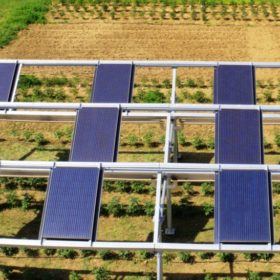
Iberdrola announces winners of agrivoltaic contest
The Spanish energy company received 110 proposals from 32 countries. Three of the four selected projects are aimed at deploying agrivoltaic solutions.
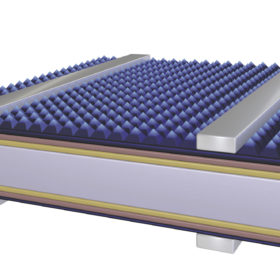
New optimizations for a 24.5% efficient heterojunction solar cell
Scientists in Germany analyzed the main sources of performance loss in a silicon heterojunction cell, and developed several optimization strategies to improve overall performance. By adding a second layer of amorphous silicon at the rear of the device, and a magnesium fluoride anti-reflective layer, they were able to boost cell efficiency by around 1% to reach 24.51%.
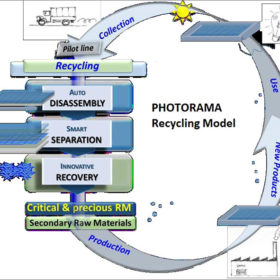
European consortium develops pilot line for complete PV module recycling
A European consortium consisting of Italian energy agency Enea and the French Alternative Energies and Atomic Energy Commission, among other entities, has developed a plan to build a low-emissions pilot line to recover critical and precious metals such as silicon, indium, gallium and silver. The line will be designed to reintroduce new materials and new products into the production cycle.

The solar facade with a golden glow
A 163 kW solar façade is powering the new building of Basel’s Office for Environment and Energy in Switzerland. Swiss manufacturer Megasol provided special modules on 3D fused glass for the vertical BIPV installation.
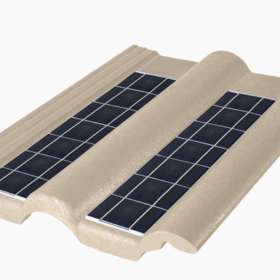
New solar tile from Brazil
Developed by Brazilian construction materials provider Eternit S.A., the tile has a nominal power of 9.1 W and an average monthly generation capacity of 1.15 kWh. It is available in five colors and two versions with a classic or reinforced design.
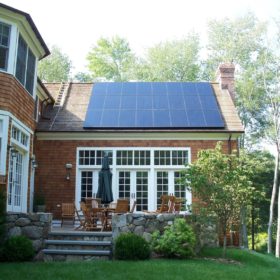
Fire risks for rooftop solar
A recent study by Clean Energy Associates showed that 90% of inspected rooftops had significant safety and fire risks. Here’s how to protect your solar asset.
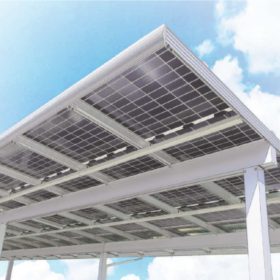
Scalable turnkey solar carport solution for commercial applications
Japanese energy company Sinanen offers a scalable solar carport that can host a minimum of four vehicles and can be deployed in the parking areas of factories and commercial buildings. The basic system is offered with a minimum capacity of 10.80 kW.

The Hydrogen Stream: Toyota and Kawasaki want to develop hydrogen engine
Kawasaki Heavy Industries and Yamaha Motor revealed plans to develop hydrogen engines for two-wheeled and other vehicles. Meanwhile, France-based Hyvia has announced two new prototypes of hydrogen-powered light commercial vehicles, Germany’s ThyssenKrupp is considering listing its hydrogen business in an initial public offering (IPO), and Potruguese utility EDP said it wants to invest in 1.5 GW of renewable hydrogen by 2030.
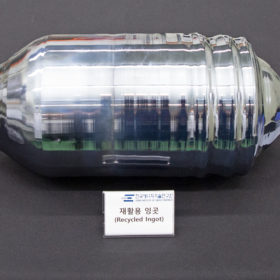
New tech to produce ultra-thin wafers with minimal silicon waste
South Korean researchers have developed a process to produce ultra-thin wafers without sacrificing any of the substrates. Their technique is based on a new approach involving the use of plasma-assisted epitaxial growth, in order to increase internal defects and porosity, rather than reduce them.

How to convert coal mine goaves into pumped hydro storage facilities
According to Chinese researchers, using abandoned coal mine goaves for pumped hydro facilities in combination with large scale solar and wind is not only technically feasible but can also provide an efficiency of 82.8% in yearly operation cases. They applied the model to wind and solar-rich northwestern and southwestern China.
