
Northvolt plans to expand gigafactory in Poland
The Northvolt manufacturing facility in Gdansk should become Europe’s largest factory for energy storage solutions. The production is scheduled to begin in 2022 with an annual capacity of 5 GWh. The company wants to expand it to 12 GWh.

The best materials for carrier multiplication in solar cells
Researchers in the Netherlands have sought to identify all those semiconductor materials that may make the application of carrier multiplication in photovoltaics much more than a mere suggestion. According to them, the bandgap of the materials should be between 0.6–1.0 electronvolt (eV), which would result in maximum theoretical efficiency of around 44%. 2D and bulk materials were indicated as the most promising with near-ideal carrier multiplication.
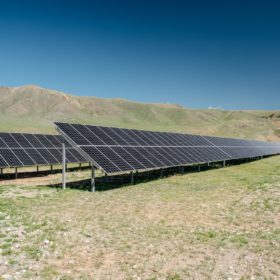
Geo-referenced approach to identify communities that can afford PV mini-grids
The novel methodology can be used for 71 countries located across ‘sun belt’ areas of east Asia, South Asia, and sub-Saharan Africa. The model relies on 2014 and 2015 geo-referenced datasets in various formats and spatial resolutions, as well as on a population dataset based on global human settlements (GHSL) and World Bank national-level estimates of electrification.

New method to produce silicon anodes for lithium-ion batteries
Scientists in Sweden developed a new aerogel process to manufacture silicon anodes for lithium-ion batteries, promising to offer batteries with greatly increased capacity compared to those on sale today. By growing nanometer-sized particles of silicon onto graphite, the group was able to demonstrate a device that overcomes many of the challenges common to silicon as anode material. While there are still challenges in terms of stability and capacity retention, the approach could ultimately yield low-cost, large-scale production processes.
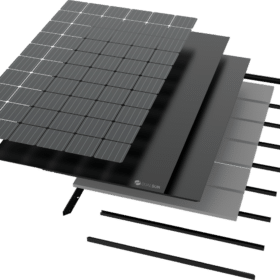
Dualsun unveils 375 W photovoltaic-thermal panel with shingle tech
The panel features an efficiency of 20% and a thermal power of 600 W-thermal per square meter.
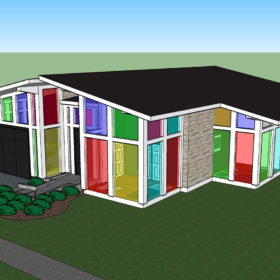
Solar window based on luminescent solar concentrators
U.S. scientists have put luminescent solar concentrators in a windowpane to absorb certain light wavelengths and transmit them to solar cells. The concentrators are made of a conjugated polymer sandwiched between window layers.
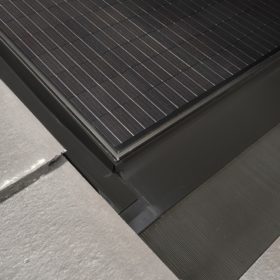
Viridian Solar unveils roof-integrated solar panels with power of 335/340 W
The new devices feature efficiencies ranging from 20.7-21%. The panels are said to be compatible with a wide range of slates and tiles, include special fixings for different batten thicknesses, and achieve the highest fire rating and wind resistance without modifications to the roof.

Green hydrogen production via 20 MW electrolyzer at Italian oil refinery
A refinery of Italian oil product provider Saras will host a large scale electrolyzer that will produce hydrogen to be used as a raw material in the refinery itself. The green energy production will be set up by Italian energy company Enel.

SolarEdge to supply electric powertrain units, batteries for Fiat EV
SolarEdge e-Mobility will supply Fiat with full electrical powertrain units and batteries for the automaker’s E-Ducato light commercial vehicle.

First attempt to fabricate solar cells based on antimony selenoiodide
South Korean scientists have produced a solar cell based on antimony selenoiodide, with a 4.1% efficiency, a short-circuit current density of 14.8 mA cm2, an open-circuit voltage of 473.0 mV, and a fill factor of 58.7%. They claim the cell exhibits excellent stability in humid conditions.
