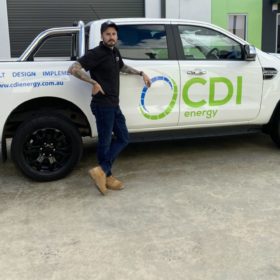
Mobile, quick-install mounting system for medium and large scale projects
An Australian innovator has designed a secure racking system he says enables super-fast installation of solar fields, which can then be relocated as needed.
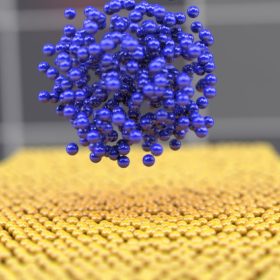
Amorphous lithium discovery could lead to new high-performance batteries
Researchers have set out to study the kinetics of lithium deposition during cycling in a battery. By changing different parameters, they’ve found that it’s fairly easy to put lithium into amorphous form, which is superior on an electromechanical level.
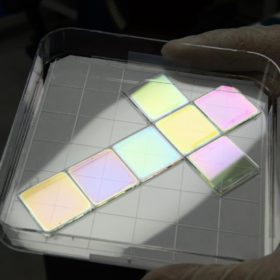
Cadmium-free CIGS solar cell with 18% efficiency
South Korean scientists manufactured the cell with the chemical bath deposition method, using different thiourea concentrations. For the buffer layer, they used zinc instead of cadmium sulfide. The cell is flexible and is available in seven different colors.

A step forward for single-crystal perovskites
Scientists in the United States have developed a lithography-based process for the fabrication of single-crystal perovskites. Thin films made using this process have been integrated into a range of devices, including solar cells, and have demonstrated better stability performance than their more commonly researched polycrystalline counterparts.
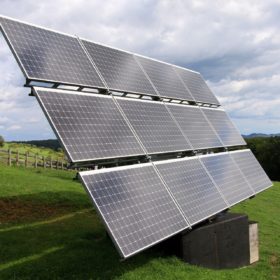
Fuzzy logic MPPT to improve PV system performance
A Pakistani-Chinese research group has demonstrated a new maximum power point tracking method, based on a fuzzy logic algorithm to provide faster results. The converter tech is claimed to have an impact on PV system efficiency and provide isolation between the load and the PV array.

Perovskite structure also benefits batteries
Scientists at Germany’s Karlsruher Institute of Technology are leading an investigation into a new lithium-ion battery anode. The innovation has a perovskite crystalline structure and, according to the researchers, could provide strong all-round performance from simpler, cheaper production methods than those used for other anode materials.

Hydrogen storage in salt caverns in France
Hydrogène de France and gas grid company Teréga plan to launch a feasibility study for a 1.5 GWh pilot hydrogen storage project in caverns in the southwest of the country.
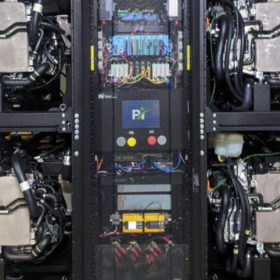
Microsoft trials hydrogen-powered data centers
The software giant has begun testing hydrogen fuel cells as a back-up power source at one of its U.S. data centers. A 250 kW pilot system successfully powered part of the facility for 48 hours and the company is now eyeing 3 MW systems to replace back-up diesel generators.

Grid constraints threaten to curtail more than 1 GW of solar projects in North Queensland
The northern Australian region this week added nine solar plants to the two already threatened – along with a wind farm – with having their output halted under certain conditions.
New solar+storage converter for greater grid stability
Scientists from the Institute of Electrical and Electronics Engineers have presented research suggesting a new topology for residential solar+storage inverters.
