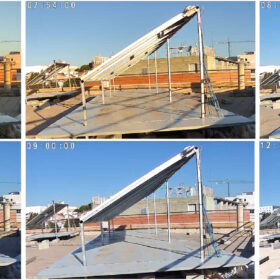
Precise backside irradiance modeling for bifacial PV is often unnecessary
A European research group has developed a new “empirical” method for measuring the backside irradiance of bifacial PV system. The proposed approach was tested across several European locations and it was found to enable annual performance calculations with a fixed backside irradiance share value.
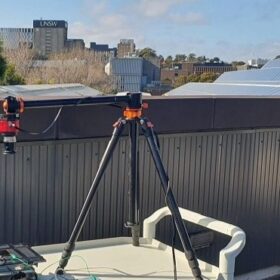
Using photoluminescence, implied open-circuit voltage imaging for perovskite solar cell field testing
To evaluate the outdoor performance and stability of perovskite solar cells using contactless and noninvasive methods, an Australian and Chinese research team found a way to use photoluminescence imaging as well as demonstrating a proof of concept for implied open-circuit voltage (iVOC) imaging. Their research relied on cost-effective equipment that operates under direct sunlight.
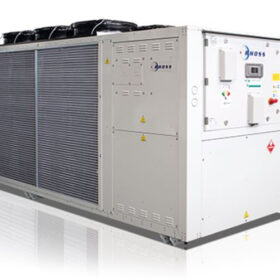
Rhoss launches reversible heat pumps
Conceived for industrial applications, the novel heat pumps can reportedly deliver hot water at 65 C from -10 C up to 35 C of external air, and hot water at 55 C down to -20 C of external air. Their coefficient of performance reaches up to 3.47.

Photovoltaics for cargo ships
Wattlab has installed a PV system capable of delivering up to 35 kW to a cargo ship’s high-voltage propulsion system, allowing it to temporarily replace one of four diesel generators under optimal conditions.
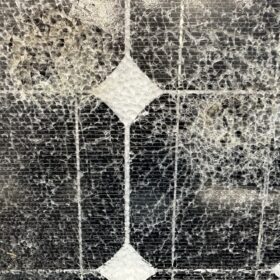
Upcycling solar glass waste to use in solid-state lithium batteries
Nanyang Technological University researchers have milled solar panel glass waste for use in cathodes used in solid state lithium metal batteries. When used as a functional filler in solid polymer electrolyte (SPE) material, the resulting battery performance was maintained over 80 charge cycles with an 8.3 % improvement over the reference device.
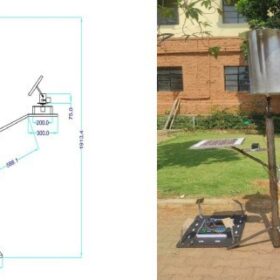
Solar-wind tree based on 2-axis tracking
Scientists in india have created a wind-solar system in a tree shape, which combines wind turbines and a PV system with two-axis trackers. The team constructed a hardware-in-the-loop prototype that can generate up to 444.5 Wh per day.
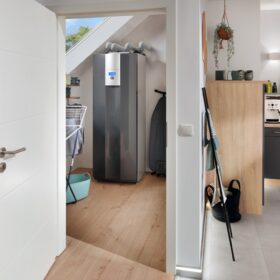
Ait-Group launches residential heat pumps with low propane charge
Germany’s Ait Group has introduced residential ground-source heat pumps using less than 150 grams of propane, based on results from the Fraunhofer ISE LC150 research project. The new systems deliver up to 6 kW of heating with a seasonal coefficient of performance of 5.14.
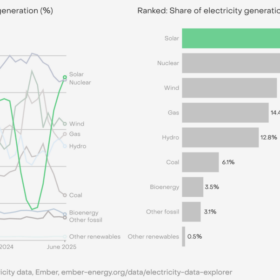
Solar becomes EU’s largest power source in June
Solar accounted for 22.1% of electricity generation in the European Union in June, as 13 member states set new records for the share of solar in their national power mixes.

Behavioral factors behind residential PV adoption in China
Researchers have combined the theory of planned behavior, the technology acceptance model, and diffusion of innovations theory to investigate rooftop solar adoption in China. From a 1,200-person survey, they found that subjective norms and social influence from peers and community had a surprisingly more substantial effect than personal attitudes or perceived ease of use.
Assessing PV cell, module reliability via Arrhenius equation
Researchers in Portugal have used the so-called Arrhenius aging model to measure the temperature behaviour and reliability of different solar modules. Their analysis showed that long-term module performance can diverge significantly depending on the manufacturing processes.
