
Desalinating water with mobile solar-powered devices
A U.K. research team has developed a desalination mechanism that could offer a new way to provide drinking water and irrigate remote areas affected by natural disasters. Although the portable device is still in an initial, experimental phase, it can be powered by solar energy, as it has no moving parts and only requires small amounts of electricity.
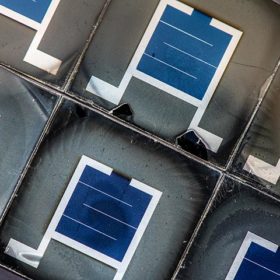
A new solution for perovskite stability
By tweaking the chemical composition of the material to create a ‘triple’ perovskite, scientists at the U.S. National Renewable Energy Laboratory say they have overcome one of the technology’s inherent stability issues and fabricated a perovskite cell which achieved 27% efficiency in a tandem format with a silicon device.
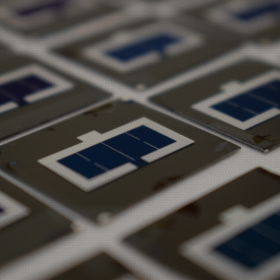
A perovksite-silicon tandem cell with 25.7% efficiency
The device exhibited a small performance loss after a 400-hour thermal stability test at 85 degrees Celsius and after the same period under maximum power point tracking at 40 degrees Celsius, according to its developer. The cell was made by combining solution-processed, micrometer-thick perovskite top cells with fully-textured silicon heterojunction bottom cells.

Australian government redirects funding for Energy Transition Hub
The Australian federal government said last week that it will curtail funding for the five-year Energy Transition Hub research initiative.

Solar-powered trees for cool spots in urban hot spots
A Japanese consortium has started producing solar-powered ‘urban furniture’. The result is a solar-plus-battery bench with cooling elements and vaporizers.

Canadian Solar claims 23.81% efficiency for n-type poly module
The Chinese-Canadian manufacturer said the new results improve upon its previous record by around 1%. The achievement has been certified by Germany’s Institut für Solarenergieforschung GmbH (ISFH).
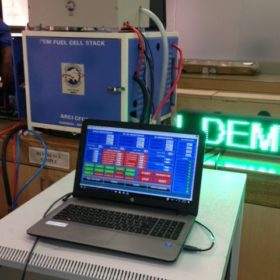
Fuel cell technology to power disaster management systems
Fuel cell systems provide sustainable electricity using hydrogen gas, without the need for grid power, which makes them highly useful in medical centers, as such facilities need to respond immediately in emergencies with state-of-the-art communication platforms.
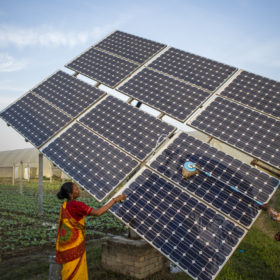
Solar will turn vicious water-energy-climate cycle into virtuous loop
The International Water Management Institute is promoting the Solar Irrigation for Agricultural Resilience (SoLAR) initiative to expand the use of solar irrigation systems throughout Bangladesh, India, Nepal, and Pakistan. Proponents of solar irrigation pumps say that they can have a strong positive impact on groundwater.
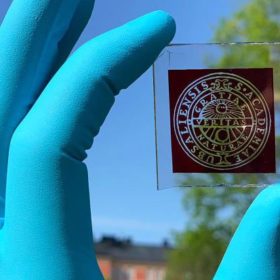
A 34% efficient dye-sensitized device for indoor PV
A European research team has developed a dye-sensitized PV cell based on a copper iodide complex. The device was conceived for use in self-powered and internet of things devices.
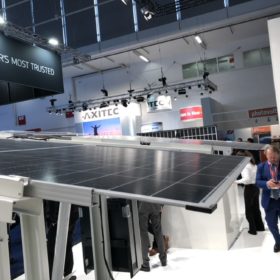
Trina announces 23.39% efficient, commercially produced PERC cell
The Chinese manufacturer believes it has set a record because its device was manufactured on standard commercial production equipment.
